
Best HDMI Audio Extractors and HDMI Switches: Top 5 Picks for Better Home Entertainment
Choosing the right HDMI accessory can make your home entertainment setup easier to manage, whether you want to connect a soundbar, extract audio from a television, switch between gaming consoles, or enjoy high-resolution video on a compatible display. The best choice depends on your equipment, supported resolutions, audio formats, and the connections available on your TV or monitor.
In this guide, we compare five HDMI accessories, including audio extractors with optical and analog outputs, an advanced eARC-compatible extractor, a compact bidirectional HDMI switch, and a multi-input HDMI switch with remote control. Each option serves a different purpose, so understanding the differences can help you choose the right accessory for your entertainment system.
Note: The products listed below are HDMI accessories rather than air fryers. The recommendations and comparisons therefore focus on their actual HDMI and audio capabilities.
Quick Comparison: Top 5 HDMI Accessories
1. HDMI ARC Audio Extractor

For ARC audio connections and soundbar integration.
2. VPFET HDMI Audio Extractor

For extracting audio from compatible HDMI sources.
3. 8K Bidirectional HDMI Switch

For switching between two HDMI sources or compatible displays.
4. J-Tech Digital 8K Extractor

For advanced HDMI audio extraction and high-resolution systems.
5. 3-in-1 HDMI 2.0 Switch
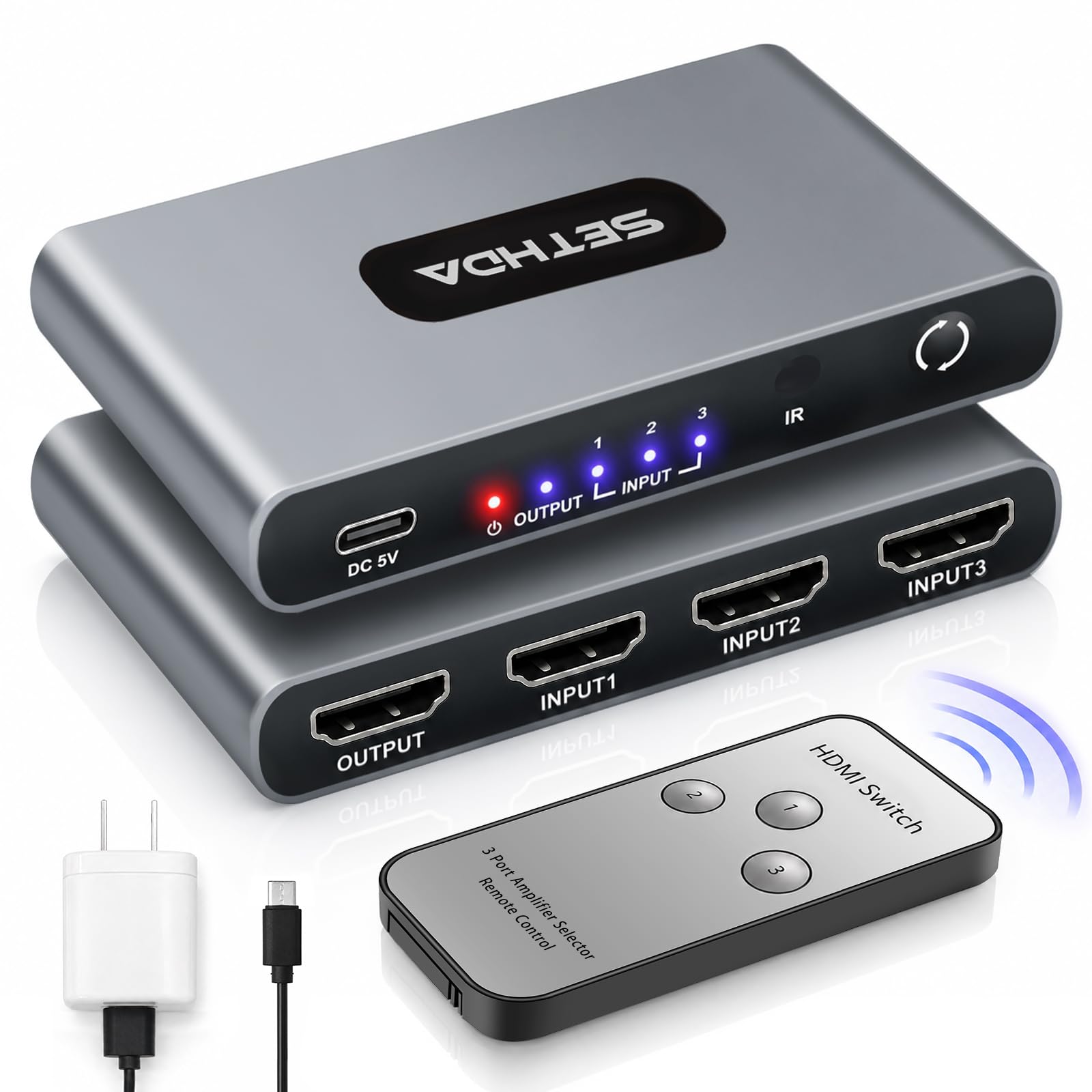
For connecting multiple HDMI sources to one display.
What to Consider Before Buying an HDMI Accessory
Before choosing an HDMI accessory, identify the problem you need to solve. An audio extractor separates sound from an HDMI signal and routes it through supported audio outputs. An HDMI switch, on the other hand, lets you connect multiple source devices to one display or, with a bidirectional model, use a compatible alternative connection arrangement. These devices are not interchangeable.
Resolution and refresh rate are also important. A device advertised for 4K at 30Hz is different from one designed for 4K at 120Hz or 8K at 60Hz. The complete signal path must support the desired resolution, refresh rate, HDR features, and bandwidth. Your source device, cables, switch or extractor, and display all play a role.
For audio, check whether you need optical TOSLINK, stereo 3.5mm, analog left/right RCA, or an HDMI ARC/eARC connection. Audio format support varies, and a device that supports multichannel digital audio may not provide every format through every output. Check the manufacturer’s specifications for the exact model and intended setup.
Detailed Product Reviews
1. HDMI ARC Audio Extractor, 4K 30Hz, eARC to Soundbar Optical 3.5mm Converter
The HDMI ARC Audio Extractor is intended for users who need to connect compatible HDMI audio equipment to a soundbar or another audio device with a different input type. Its advertised combination of ARC/eARC-related functionality and optical or 3.5mm audio connectivity makes it worth considering for home entertainment setups where the television and audio equipment do not share the same available connections.
The advertised 4K 30Hz specification is an important consideration when planning a system. It may be suitable for certain streaming devices, older media players, and everyday viewing arrangements, but it should not be assumed to support higher-refresh-rate gaming. Confirm the exact video pass-through capabilities, supported HDMI modes, and compatibility with your television before buying.
For the best results, verify the ARC/eARC requirements, audio output formats, and connection direction in the product documentation. ARC and eARC are related but distinct technologies, so the presence of eARC in a product title does not automatically establish support for every eARC feature or high-bandwidth audio format. Check whether the device meets your particular soundbar or receiver requirements.
Key Features
- Designed for compatible HDMI ARC/eARC audio setups.
- Advertised support for 4K at 30Hz.
- Optical and 3.5mm audio connection options, as indicated in the product title.
- Potentially useful for bridging different audio connection types.
- Requires confirmation of exact audio formats and supported connection modes.
Pros and Cons
| Pros | Cons |
|---|---|
| Offers potential connectivity between compatible HDMI and external audio equipment. | The advertised 4K 30Hz limit may not suit high-refresh-rate gaming. |
| Optical and 3.5mm options can help accommodate different audio inputs. | Exact eARC, audio-format, and device compatibility should be verified. |
| Useful for selected home theater configurations. | May require careful configuration of television audio settings. |
Who Should Buy It?
Consider this extractor if you need to connect compatible television audio to an optical or analog audio device and have confirmed that the model supports your connection arrangement. If you use a modern gaming console or need advanced high-refresh-rate video pass-through, verify those requirements before making a purchase.
Verdict: A potentially useful connection solution for compatible home entertainment systems, particularly when audio output compatibility matters more than high-refresh-rate video. Check the current listing and technical documentation for the precise capabilities.
2. VPFET HDMI Audio Extractor 4K to Optical and 3.5mm AUX
The VPFET HDMI Audio Extractor is designed for people who want to separate audio from an HDMI source and route it to an audio system with an optical or 3.5mm AUX input. This type of adapter can be useful when a monitor lacks built-in speakers or when an existing speaker system does not accept the audio connection available on a media player, computer, or other HDMI source.
Its product title advertises 4K HDMI support and compatibility with digital audio formats, including DTS 5.1 and PCM. Buyers should check the listing’s exact supported resolution, refresh rate, HDCP version, and audio output behavior. In particular, multichannel output availability can depend on the selected output, source settings, and connected receiver or speakers.
Installation generally involves connecting the HDMI source and display, then attaching a compatible audio device to the extractor’s available output. If sound is missing or distorted, check the source’s audio settings, the display’s audio-routing options, and the selected PCM or bitstream mode. Verify whether external power is required and follow the supplied instructions for the specific device.
Key Features
- HDMI audio extraction for compatible source devices.
- Advertised 4K support, subject to the product’s precise specifications.
- Optical digital audio and 3.5mm AUX connectivity.
- Product listing references DTS 5.1 and PCM audio support.
- Useful for selected monitor, television, and external speaker arrangements.
Pros and Cons
| Pros | Cons |
|---|---|
| Provides a way to route HDMI audio to compatible external equipment. | Audio output depends on format and device compatibility. |
| Offers optical and analog audio connection choices. | The exact high-refresh-rate and HDR capabilities need confirmation. |
| Can help integrate existing speakers into an HDMI-based setup. | Additional cables and configuration may be necessary. |
Who Should Buy It?
This model is worth investigating if you have a compatible HDMI source and want to use existing optical or AUX-equipped speakers. It may be especially relevant to desktop users, home theater enthusiasts, and people upgrading the audio arrangements around an HDMI display.
Verdict: A practical category of accessory for users who need additional audio connectivity. Confirm its actual supported video modes and the digital formats available through each output before ordering.
3. 10K 8K HDMI Switch, 2 in 1 Out Bidirectional HDMI Switcher
The 10K 8K HDMI Switch is aimed at users who need flexible HDMI connectivity without adding a large switching system to their desk or entertainment center. Its advertised bidirectional design is a key distinction. Depending on the manufacturer’s specified operating mode, a two-port bidirectional switch can be used to select between two HDMI sources feeding one display or to direct one source to one of two compatible displays, but it generally does not send one source to two displays simultaneously.
The listing references 8K and 10K video, which makes verification of the exact supported resolution and refresh rate particularly important. A headline resolution does not guarantee every combination of refresh rate, HDR, variable refresh rate, or advanced gaming features. The cables and connected equipment must also support the required bandwidth. Check the product documentation if you intend to use it with a high-end graphics card, a gaming console, or a high-refresh-rate monitor.
For everyday use, a compact switch can reduce the need to repeatedly unplug and reconnect HDMI cables. It can be convenient for a workstation shared by a desktop computer and laptop, or for a television used with more than one media source. Before purchase, confirm whether switching is manual or automatic, whether external power is needed, and which HDCP and HDMI features are supported.
Key Features
- Advertised 10K and 8K HDMI switching capability.
- Bidirectional operating concept for compatible configurations.
- Two-source-to-one-display or one-source-to-one-of-two-displays use, according to the supported mode.
- Potentially useful for gaming, desktop, and media equipment.
- Actual refresh rates and advanced video features should be checked before buying.
Pros and Cons
| Pros | Cons |
|---|---|
| Bidirectional design can support more than one useful connection arrangement. | Does not necessarily display one source on two screens simultaneously. |
| Can reduce cable swapping between compatible HDMI devices. | Actual resolution, refresh rate, and feature support require verification. |
| Potentially useful for modern gaming and display equipment. | Compatibility depends on the entire HDMI signal chain. |
Who Should Buy It?
Consider this switch if you want to share a compatible display between two HDMI sources or need a bidirectional connection arrangement. Gamers and professional users should verify the exact refresh rate, resolution, HDR, and other features they need rather than relying on the headline 8K or 10K label alone.
Verdict: A potentially convenient solution for simplifying HDMI connections in a modern setup. Its value depends on whether the supported switching mode and verified signal specifications match your equipment.
4. J-Tech Digital 8K HDMI Audio Extractor with eARC and ARC
The J-Tech Digital 8K HDMI Audio Extractor is designed for more advanced entertainment systems that need to coordinate high-resolution video with external audio equipment. The product title advertises 8K at 60Hz and 4K at 120Hz, along with ARC/eARC functionality and optical or left/right audio conversion. These advertised features make it a candidate for evaluation in systems combining modern displays, gaming hardware, and external audio equipment.
The inclusion of ARC/eARC-related features may be helpful for users who need to route television audio through a compatible sound system. However, eARC capability, HDMI video pass-through, and the audio formats available through optical or analog outputs are separate considerations. Optical connections, for example, do not support every high-bandwidth audio format that may be available through eARC. Check the manufacturer’s compatibility chart to ensure the desired audio signal can reach your equipment.
The advertised 4K 120Hz mode is particularly relevant to compatible gaming consoles and PCs, but successful operation depends on the exact implementation and the rest of the setup. Verify support for the features you rely on, including HDR formats, HDCP 2.3, CEC behavior, and EDID settings. These features can affect handshake behavior, video compatibility, and how the source identifies the capabilities of the connected display and audio equipment.
Key Features
- Advertised 8K at 60Hz and 4K at 120Hz video modes.
- ARC/eARC-related audio connectivity.
- Optical and left/right audio conversion options, as stated in the listing.
- Listing references HDCP 2.3, HDR, CEC, and EDID functionality.
- Designed for consideration in advanced home theater and gaming systems.
Pros and Cons
| Pros | Cons |
|---|---|
| Advertises modern high-resolution and high-refresh-rate video modes. | Actual performance depends on source, display, cables, and device configuration. |
| Offers ARC/eARC-oriented connectivity for supported systems. | Optical and analog outputs may not carry every advanced digital audio format. |
| Advertises HDCP, HDR, CEC, and EDID-related features. | Advanced configurations may require troubleshooting or settings adjustments. |
Who Should Buy It?
This extractor deserves consideration if you are building a modern home theater or gaming setup and need both video pass-through and audio-routing flexibility. It is especially important to verify that the exact product version supports your preferred video mode and the audio format required by your soundbar or receiver.
Verdict: An option to investigate for advanced HDMI systems where audio extraction and modern video specifications are important. Review the manufacturer’s detailed specifications before relying on any particular resolution, refresh rate, or audio format.
5. HDMI 2.0 Switch, 3 in 1 Out, 4K at 60Hz with Remote and Charger
The HDMI 2.0 Switch is designed for users who have several HDMI source devices but only one available display input. Its advertised three-input, one-output arrangement allows compatible sources such as a gaming console, streaming device, Blu-ray player, laptop, or another media device to share one television or monitor. Instead of constantly changing cables, users can select the desired input through the supported switching controls.
The product title advertises 4K at 60Hz and references Dolby, 3D, HDR, HDCP 2.2, and CEC compatibility. These specifications can be useful for everyday entertainment, but actual support depends on the device’s implementation and the connected equipment. HDMI 2.0-class switching is not equivalent to full-bandwidth HDMI 2.1 switching, so users who need 4K at 120Hz or certain advanced gaming features should consider a device explicitly designed for those requirements.
A remote control can make input selection more convenient when the switch is placed behind a television or inside an entertainment cabinet. The listing also references a charger, but buyers should check the package contents and power requirements before purchasing. For reliable operation, use suitable HDMI cables, connect each source to the correct input, and verify the output signal on the display after selecting a source.
Key Features
- Three HDMI inputs and one display output.
- Advertised 4K at 60Hz support.
- Remote control for convenient source selection.
- Listing references Dolby, 3D, HDR, HDCP 2.2, and CEC compatibility.
- Advertised aluminum construction and included power accessory, subject to listing confirmation.
Pros and Cons
| Pros | Cons |
|---|---|
| Connects up to three compatible HDMI sources to one display. | Does not provide three independent display outputs. |
| Remote control can simplify switching between devices. | The advertised 4K 60Hz capability may not suit 4K 120Hz gaming. |
| May reduce cable swapping in home entertainment setups. | Actual HDR, CEC, and HDCP behavior depends on equipment compatibility. |
Who Should Buy It?
This switch is worth considering if your television or monitor has limited HDMI inputs and you want to connect several media devices. It can be a convenient option for users who switch between streaming, console gaming, and other HDMI sources, provided the advertised video specifications meet their needs.
Verdict: A straightforward option for consolidating several HDMI sources into one display connection. Its three-input arrangement and remote-control functionality are useful advantages for compatible entertainment systems, while high-refresh-rate gamers should look for verified support for their specific requirements.
Comparison: Which HDMI Accessory Is Right for You?
| Product | Main Purpose | Advertised Specification | Best Fit |
|---|---|---|---|
| HDMI ARC Audio Extractor | Audio extraction and conversion | 4K 30Hz; optical and 3.5mm | Compatible soundbar and audio connections |
| VPFET Audio Extractor | HDMI audio separation | 4K; optical and AUX | External speakers and compatible audio systems |
| 10K 8K Bidirectional Switch | HDMI source/display switching | Advertised 8K and 10K | Compatible gaming and display arrangements |
| J-Tech Digital Extractor | Advanced audio extraction and video pass-through | Advertised 8K 60Hz and 4K 120Hz | Advanced home theater and gaming setups |
| 3-in-1 HDMI Switch | Three sources to one display | Advertised 4K 60Hz | TVs and monitors with limited HDMI inputs |
Frequently Asked Questions
1. What is the difference between an HDMI audio extractor and an HDMI switch?
An HDMI audio extractor separates audio from a compatible HDMI signal and routes it to supported audio outputs, such as optical or analog connections. An HDMI switch selects between multiple HDMI sources or, in the case of a bidirectional model, supports a specified alternative connection arrangement. Choose an extractor when you need audio routing and a switch when you need input selection.
2. Can an HDMI audio extractor connect a TV to a soundbar?
Some extractors support television audio connections through ARC or eARC, while others are designed primarily for audio extraction from a source device. Check the device’s exact supported operating modes, connection direction, and soundbar compatibility. Not every extractor supports audio return from a television.
3. Does an 8K HDMI switch automatically support 4K at 120Hz?
No. An 8K label alone does not establish support for every refresh rate or HDMI 2.1 feature. Confirm the specific resolution and refresh-rate combinations, bandwidth, HDR support, and any gaming features listed by the manufacturer.
4. Will an HDMI switch improve picture quality?
An HDMI switch generally selects and passes through a compatible signal rather than enhancing its image quality. The resulting picture depends on the source, display, cables, and the switch’s supported signal specifications. An incompatible switch can limit available resolutions or prevent certain features from working.
5. Do HDMI audio extractors support Dolby and DTS?
Support varies by model and output. Some devices pass certain Dolby or DTS digital formats through optical outputs, while analog outputs generally provide stereo audio. Check the specific format, channel configuration, and output restrictions before purchasing.
6. Is an external power supply necessary?
Some HDMI accessories require external power, while others may operate without a separate adapter under supported conditions. Review the product listing and manual for power requirements, included accessories, and any recommendations for long cable runs or demanding configurations.
7. Can a three-input HDMI switch display all three sources at once?
A conventional three-input, one-output switch selects one source at a time. It does not combine multiple sources into a single screen. Viewing multiple sources simultaneously requires a compatible multiviewer or video processor instead.
8. How can I fix missing sound after connecting an HDMI extractor?
Check that all cables are connected to the correct ports, select the appropriate audio output on the source or TV, and confirm that the chosen audio format is supported by the extractor and receiving device. Try PCM stereo if a receiver cannot decode the selected bitstream format, and check whether the product requires external power.
9. What should I check before buying an HDMI switch for a gaming console?
Confirm the required resolution and refresh rate, HDR support, HDCP compatibility, and any features such as variable refresh rate or automatic low-latency mode that matter to your setup. Verify that the switch and all connected cables support the complete signal path.
10. Where can I compare additional home electronics accessories?
You can explore related technology and home electronics buying guides at Omnixbuy. Compare product specifications, connection requirements, compatibility information, and current retailer listings before deciding which accessory best suits your setup.
Final Buying Recommendation
The best HDMI accessory depends on your main requirement. If you need to route HDMI audio to compatible external speakers, start by comparing the ARC-oriented extractor and the VPFET audio extractor. If your system includes a modern display and requires advanced video modes alongside audio extraction, examine the J-Tech Digital model’s detailed specifications. For users who need to simplify source selection, the bidirectional switch and the three-input HDMI switch serve different connection needs.
Before placing an order, verify the current product description, exact supported video modes, audio formats, power requirements, package contents, and compatibility with your existing equipment. Product specifications and availability may change, so consult the current listing rather than relying solely on headline features.
Use the links below to review the five products and compare their current details on Amazon.
Affiliate disclosure: As an Amazon Associate, the publisher may earn from qualifying purchases made through qualifying links, at no additional cost to the customer. Product descriptions and advertised specifications should be confirmed with the retailer and manufacturer before purchase.
Related Posts

The 5 Best Toaster Ovens for Baking, Toasting, Broiling & More
Looking for the best toaster oven for everyday cooking, perfectly…

Best Air Fryer for the Best Value: Top 5 Air Fryers and Accessories Worth Considering
Best Air Fryer for the Best Value: Top 5 Air…

The 5 Best Steam Mops The Spruce Has Tested: Top Picks for Powerful Floor Cleaning
Finding the best steam mop can make everyday floor cleaning…