
No central air? No problem. The right window air conditioner can cool a bedroom, home office, living area, or even a larger open space without the cost and complexity of installing a whole-home HVAC system. We looked at five popular window AC options with different strengths, from simple mechanical controls and compact cooling to smart features, inverter technology, U-shaped designs, and high-capacity cooling.
Whether you need a straightforward unit for a small bedroom or a powerful model for a large living area, these window air conditioners cover a range of room sizes, features, and installation preferences.
What to Look for in a Window Air Conditioner
Before choosing a window AC, consider the size of the room, cooling capacity, noise level, energy efficiency, control options, and installation requirements. A compact 5,000 BTU unit can make sense for a small bedroom, while larger rooms may need substantially more cooling capacity.
Inverter technology can provide quieter and more consistent operation by adjusting compressor output instead of relying solely on repeated start-and-stop cycles. Smart connectivity can also be useful if you want to control temperature settings from a phone or integrate the AC with a compatible smart-home system.
Detailed Window Air Conditioner Reviews
GE Profile ClearView Window Air Conditioner
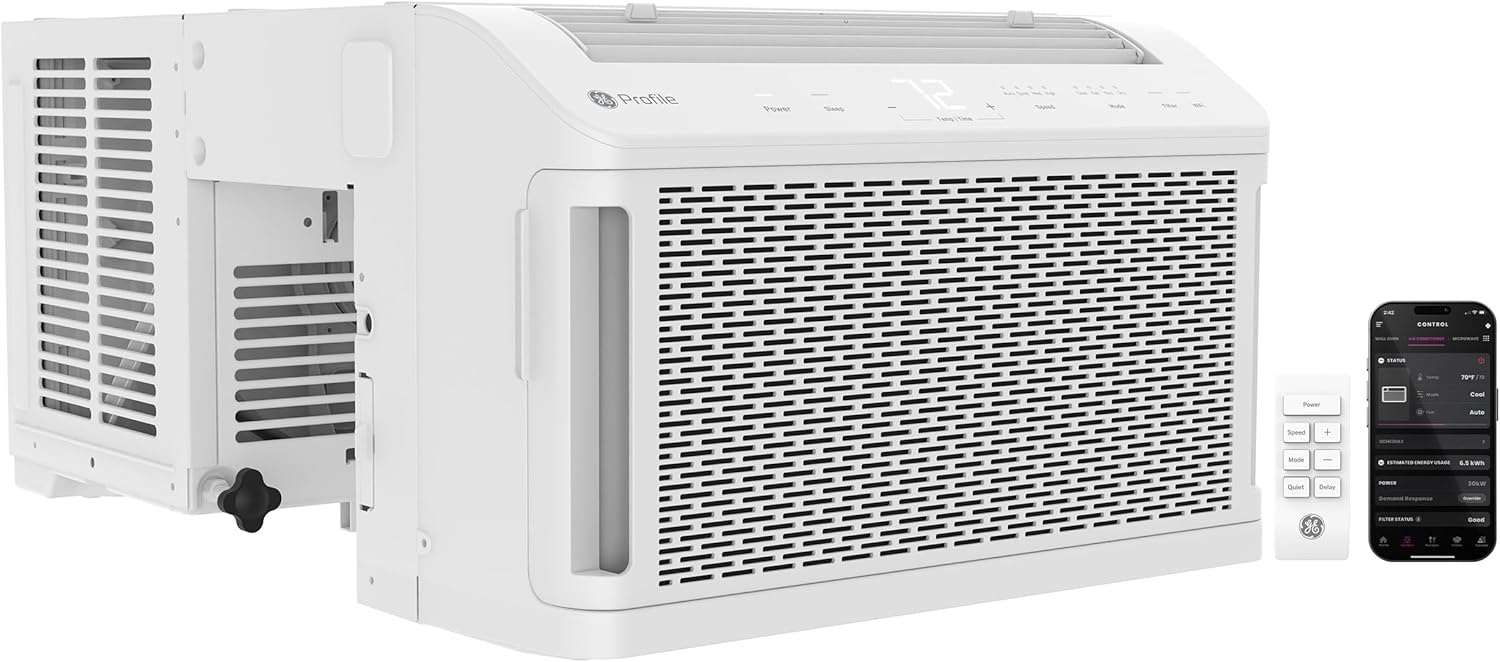
The GE Profile ClearView is designed to sit on the windowsill while leaving more of the window opening visible than many traditional window air conditioners. That makes its design particularly useful when maintaining a sense of openness and natural light is important.
Its inverter compressor is designed for efficient, low-noise cooling, making the unit a practical consideration for spaces such as bedrooms, nurseries, and home offices. Digital controls and app connectivity also provide convenient ways to adjust the settings without having to reach the unit manually.
The main consideration is installation. Its distinctive shape and longer profile can make setup more involved than a conventional window unit, so having another person available during installation can be helpful. Homes with radiators or other obstructions directly below the window may also have compatibility limitations.
| Pros | Cons |
|---|---|
| Inverter compressor | Installation can be more involved |
| Low-noise operation | May not fit every window setup |
| App and digital controls | Clearance below the window matters |
Frigidaire FFRA051WAE Window Air Conditioner

The Frigidaire FFRA051WAE takes a straightforward approach to window cooling. Its 5,000 BTU capacity is intended for smaller rooms, including bedrooms and other spaces of roughly 150 square feet, making it a practical fit when you do not need advanced technology or high-capacity cooling.
Its two-knob control system keeps operation simple. One control handles cooling while the other adjusts fan speed, and the fan can operate independently from the cooling function. This design can be useful for shoppers who prefer physical controls over smartphone apps and complicated menus.
The lack of smart connectivity is the biggest limitation for shoppers who want remote control. On the maintenance side, the washable filter helps reduce the need for disposable replacement filters. Overall, its uncomplicated design is geared toward basic, everyday room cooling.
| Pros | Cons |
|---|---|
| Simple mechanical controls | No smart controls |
| Suitable for small rooms | Limited cooling capacity |
| Washable filter | Fewer advanced features |
Windmill Smart Window Air Conditioner

The Windmill Smart Window Air Conditioner combines smart controls with inverter-based cooling and is designed for rooms of up to about 350 square feet. Its CEER rating of 15 and inverter design make energy efficiency and consistent operation central parts of its design.
For bedrooms, the lower operating settings and automatically dimming display can be useful. The fan-only mode also gives you an option for milder weather when full cooling is unnecessary. The included app adds remote control and can provide maintenance notifications related to the filter.
The smart features make this model more flexible than a basic mechanical window AC, but they may be unnecessary if you simply want physical controls. For shoppers who value app-based management, quiet operation, and maintenance reminders, the connected design offers several conveniences.
| Pros | Cons |
|---|---|
| Inverter technology | Smart features may be unnecessary for some users |
| App and remote control | More technology than a basic AC |
| Automatic display dimming | Installation is still required |
Midea U-Shaped Window Air Conditioner
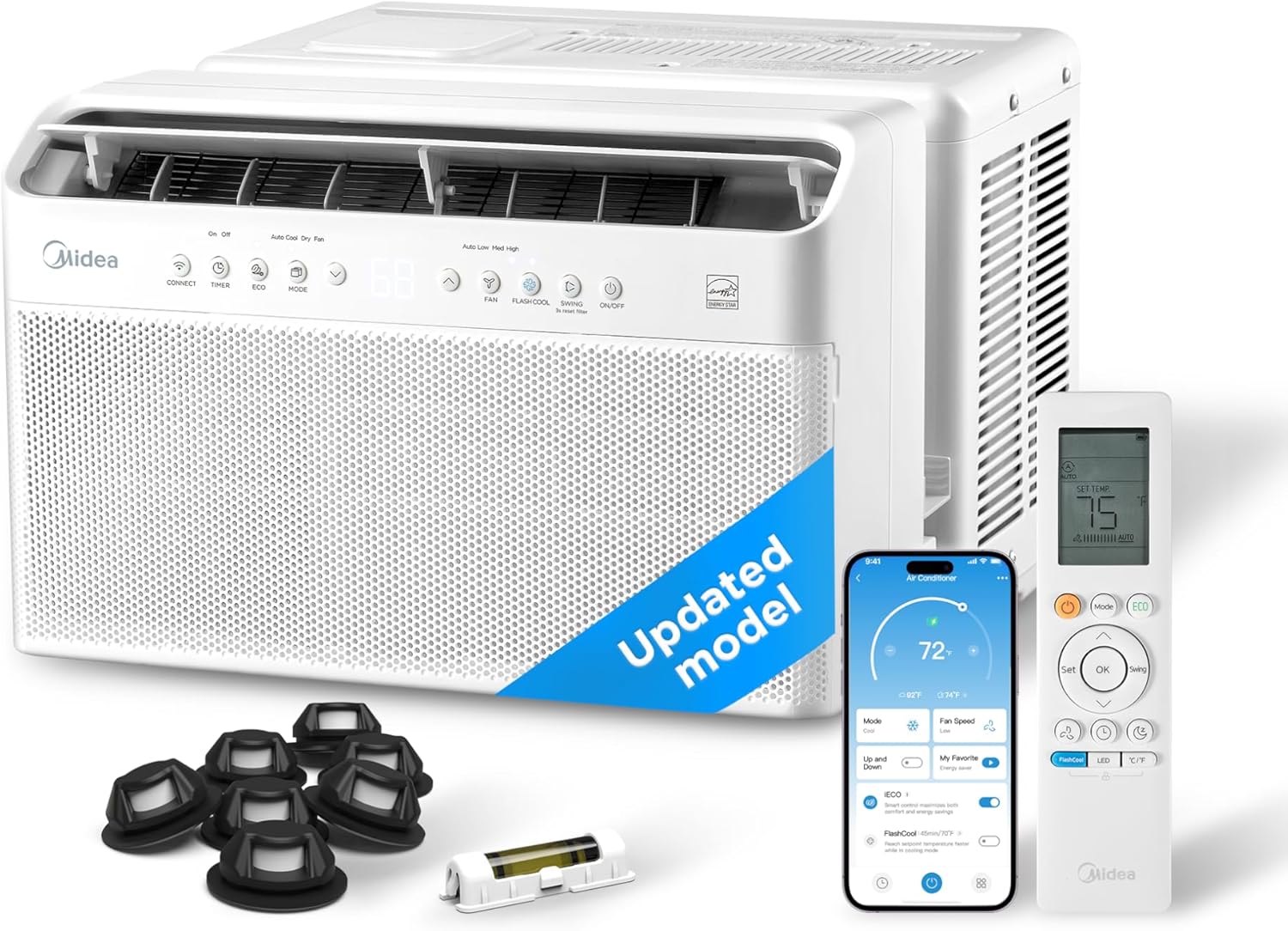
The Midea U-Shaped Window Air Conditioner uses a distinctive U-shaped design that allows the window to close farther into the unit. Once installed, this configuration separates the compressor from the indoor space with the window itself, helping reduce the amount of compressor noise heard inside.
Another advantage of the U-shaped configuration is window flexibility. The window can remain partially open through the center of the unit, allowing outdoor air into the room without completely removing the AC. This can be useful during cooler periods when you want ventilation without uninstalling the air conditioner.
Installation is the main consideration. The design requires careful setup, and some users may find it more challenging than installing a conventional window AC. For offices and bedrooms where quieter cooling is important, however, the U-shaped construction offers a different approach to managing compressor noise.
| Pros | Cons |
|---|---|
| U-shaped noise-isolating design | Installation can be difficult |
| Allows partial window opening | Requires careful mounting |
| Designed for rooms up to about 350 sq. ft. | Not ideal for every window configuration |
GE 14,000 BTU Smart Window Air Conditioner

The GE 14,000 BTU Smart Window Air Conditioner is built for substantially larger spaces than the compact models in this lineup. Its stated capacity is designed for spaces of up to about 700 square feet, making it a consideration for large living rooms and other expansive areas.
Wi-Fi connectivity gives you another way to control the unit, while the included remote provides traditional convenience. Its energy-conscious design is intended to help manage operating costs despite the larger cooling capacity, although actual results depend on room conditions, insulation, climate, and how the space is laid out.
The larger size comes with practical installation considerations. The unit is heavy, so an extra set of hands can be useful, and a support bracket may be appropriate depending on the installation. Larger-capacity window ACs can also be more noticeable acoustically, so consider the room’s purpose before choosing a high-output model.
| Pros | Cons |
|---|---|
| 14,000 BTU capacity | Heavy unit |
| Designed for larger spaces | May be noisier than smaller units |
| Wi-Fi and remote control | May require additional support depending on installation |
How to Choose the Right Window AC for Your Space
Start by matching the air conditioner’s cooling capacity to your room size. A unit that is too small may struggle to maintain a comfortable temperature, while an unnecessarily powerful model can increase upfront cost and may not be the right fit for the room or window.
Next, think about how you want to operate the AC. Mechanical controls are simple and dependable, while digital controls, remotes, Wi-Fi, and smartphone apps provide additional convenience. Inverter technology can also be worth considering if quiet and consistent operation are important priorities.
Finally, measure your window and review installation requirements before purchasing. U-shaped and specialized window AC designs can have different mounting requirements from traditional units. A proper fit is essential for safe and effective installation.
Final Thoughts
These five window air conditioners take different approaches to cooling. The GE Profile ClearView emphasizes a space-saving window design with inverter cooling and smart functionality. The Frigidaire FFRA051WAE keeps things simple with mechanical controls for smaller rooms. The Windmill adds smart controls and inverter operation, while the Midea U-shaped model focuses on its distinctive installation design and quieter indoor experience. The GE 14,000 BTU model provides substantially more cooling capacity for larger spaces.
Before ordering, compare your room size, window dimensions, desired controls, installation requirements, and cooling capacity with the current product specifications on Amazon.
Which format would you like next: :contentReference[oaicite:1]{index=1}, :contentReference[oaicite:2]{index=2}, or :contentReference[oaicite:3]{index=3}?
Related Posts

The 5 Best Electric Knives for Smooth Carving: Top Picks for Meat, Bread & Fish
Whether you are carving a Thanksgiving turkey, slicing a holiday…

The 5 Best WiFi Routers of 2026: Top WiFi 7 and WiFi 6 Routers for Fast, Reliable Home Internet
Choosing the best WiFi router can make a significant difference…

The 5 Best Grill Brushes and Grill Cleaning Tools for Easier BBQ Cleanup
Keeping grill grates clean is much easier with the right…