
Portable solar chargers can make a major difference when you’re camping, hiking, backpacking, traveling, or preparing for situations where access to a wall outlet is limited. The best models combine useful solar output with a design that is practical enough to carry outdoors.
In this guide, we look at five portable solar chargers ranging from compact 10-watt panels to a more powerful 60-watt option. The lineup includes FlexSolar and BLAVOR models, with different strengths for lightweight backpacking, charging multiple devices, and maintaining portable power banks or small power stations.
Because solar charging depends heavily on sunlight, orientation, weather, device requirements, and charging conditions, real-world performance can vary. Consider both the panel’s rated output and how you intend to use it before making a purchase.
Best Portable Solar Chargers at a Glance
How to Choose a Portable Solar Charger
- Power output: Higher-wattage panels can provide more charging potential under suitable sunlight, particularly when multiple devices are connected.
- Weight: Backpackers may prefer a compact panel that adds minimal weight to their gear.
- Ports: USB-A, USB-C, and DC connections can make a charger more versatile for phones, battery banks, and compatible portable power stations.
- Folded size: A compact folded design is easier to pack into a backpack, vehicle, or emergency kit.
- Weather resistance: Outdoor use can expose solar panels to moisture and dust, making rugged construction useful for camping and hiking.
- Charging strategy: Solar panels work best when positioned toward strong, direct sunlight and kept clear of shade.
1. FlexSolar 60W Portable Solar Panel

The FlexSolar 60W is the largest and most powerful panel in this selection, making it particularly interesting for users who need more than occasional phone charging. Its larger panel surface gives it an advantage when the goal is to collect more solar energy without moving all the way up to a large traditional solar panel.
Its USB-C connection is useful for modern electronics and compatible battery banks, while the DC connection expands its usefulness for compatible portable power stations. That makes this model a practical option for camping setups where phones, lanterns, headlamps, tablets, battery banks, or other portable equipment may need power.
The trade-off is portability. A 60W panel naturally takes up more space than smaller models when unfolded and can be heavier or bulkier to pack. For car camping, base camps, and outdoor trips where charging capability matters more than minimum weight, its larger format can make sense.
| Pros | Cons |
|---|---|
|
|
2. BLAVOR 10W Portable Solar Charger

The BLAVOR 10W focuses on portability rather than maximum power. Its compact, foldable design makes it an appealing choice for hikers, campers, travelers, and anyone who wants to keep a solar panel available without carrying a larger 40W or 60W unit.
The panel provides USB-A and USB-C outputs, giving it compatibility with a variety of everyday charging cables and devices. Its lightweight construction and folded format also make it easier to store in a backpack or emergency kit when space is limited.
A 10W panel is best viewed as a compact solar charging solution rather than a high-output replacement for a larger panel. Sun intensity and positioning have a major impact on actual output, so it is most useful when you have time to leave the panel exposed to good sunlight while charging smaller electronics or a compatible battery bank.
| Pros | Cons |
|---|---|
|
|
3. FlexSolar 40W Portable Solar Charger

The FlexSolar 40W sits between the compact 10W panels and the larger 60W option, making it a balanced choice for outdoor users who want substantial charging capability without moving to the biggest panel in the lineup. Its foldable format is designed to remain practical for adventures where weight and power both matter.
One of its main advantages is its ability to support multiple smaller devices during outdoor trips. The combination of USB-C, USB-A, and DC connectivity also gives it flexibility for compatible electronics, battery banks, and other portable equipment.
For users who frequently carry several devices, such as phones, satellite communicators, headlamps, or battery packs, the 40W capacity provides more headroom than a compact 10W charger. At the same time, it remains more manageable than a larger high-output panel, making it a versatile middle-ground option.
| Pros | Cons |
|---|---|
|
|
4. FlexSolar E10 Mini 10W Solar Panel
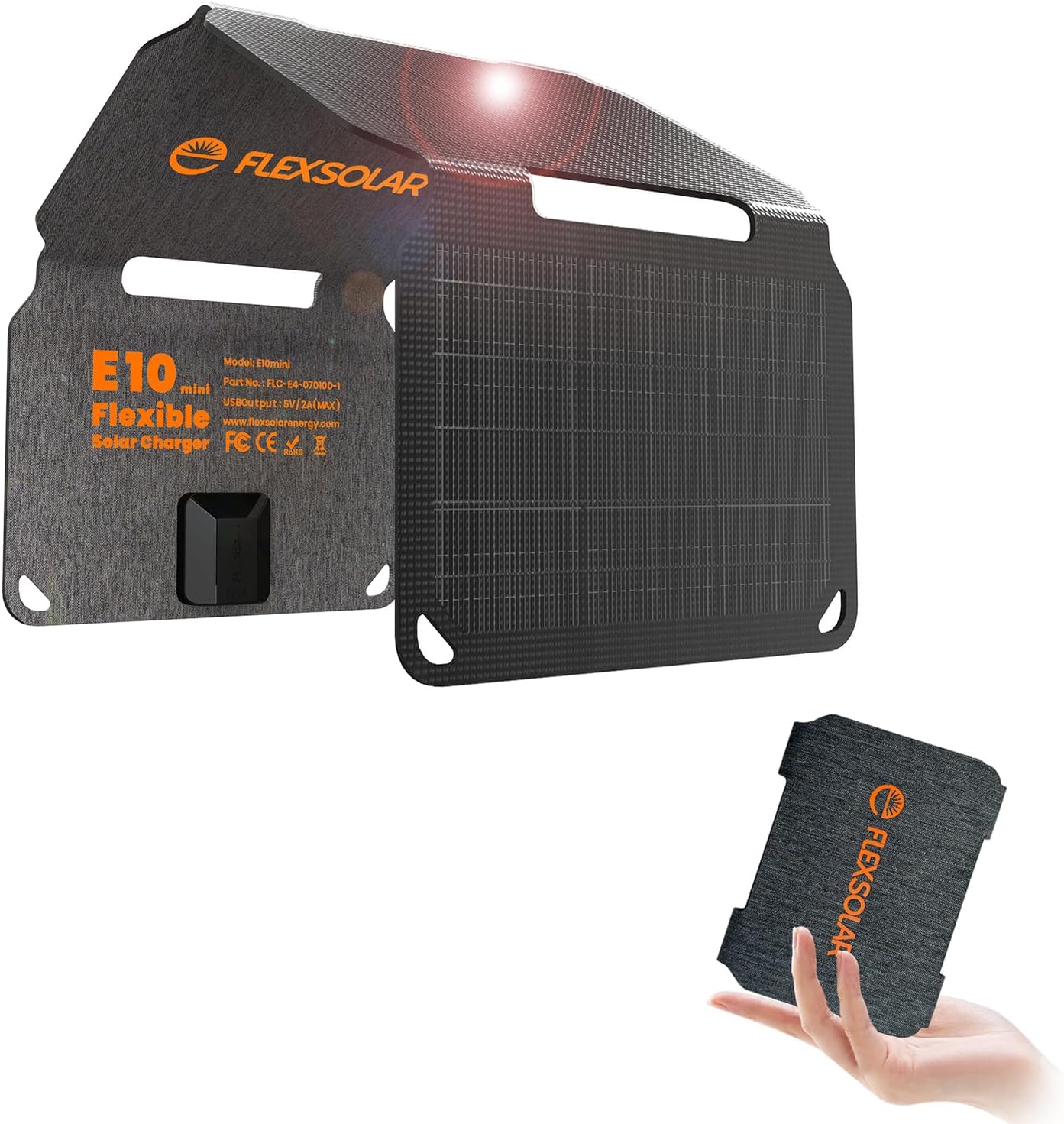
The FlexSolar E10 Mini is designed around one of the biggest priorities for backpackers: minimizing weight. At a compact 10W rating, it is not intended to compete with a 40W or 60W panel for raw output, but its lightweight design can be particularly useful for hikers who want basic solar charging capability without adding substantial bulk.
The panel folds into a compact package and opens into four connected solar sections. Its included carabiners allow it to be attached to a backpack or another suitable fixed point, which can make positioning the panel convenient during an outdoor trip.
This minimalist approach can be an advantage for users who prefer simple gear. If your primary requirement is a lightweight way to supplement charging for a phone, headlamp, small battery bank, or similar device, the E10 Mini offers a straightforward approach. As with other small solar panels, performance will depend strongly on sunlight and panel positioning.
| Pros | Cons |
|---|---|
|
|
5. BLAVOR 18W Solar Power Bank

The BLAVOR 18W takes a different approach from the separate folding solar panels in this guide by combining solar charging with a built-in portable battery. The design includes foldable solar panels around a 20,000mAh power bank, giving users an integrated way to carry both energy storage and solar collection in one unit.
The built-in battery can be useful when sunlight is temporarily unavailable because stored power can be used later. Its 18W charging capability and USB-C connectivity also make the unit suitable for compatible devices that support faster charging standards.
The main consideration is the difference between having a dedicated solar panel and having a solar power bank. An integrated design is convenient, but a separate larger solar panel can provide more flexibility when your priority is collecting solar energy efficiently. For travelers and campers who value an all-in-one design, however, the BLAVOR 18W offers a convenient combination of battery storage and foldable solar panels.
| Pros | Cons |
|---|---|
|
|
Portable Solar Charger Comparison
| Model | Rated Output | Design Focus | Connections / Storage | Best-Suited Use |
|---|---|---|---|---|
| FlexSolar 60W | 60W | Higher-output foldable panel | USB-C, USB-A, DC | Camping, multiple devices, compatible power stations |
| BLAVOR 10W | 10W | Compact portable panel | USB-C, USB-A | Travel, hiking, smaller electronics |
| FlexSolar 40W | 40W | Balanced power and portability | USB-C, USB-A, DC | Backcountry trips and multiple devices |
| FlexSolar E10 Mini | 10W | Ultra-light minimalist panel | USB charging | Backpacking and lightweight gear kits |
| BLAVOR 18W | 18W | Solar panel plus power bank | USB-C and integrated battery | Travel and all-in-one emergency charging |
Which Portable Solar Charger Fits Your Needs?
If you want the most charging capacity among these five options, the FlexSolar 60W is the highest-rated panel in the lineup and offers both USB and DC connectivity. It is particularly suited to situations where you need to support several types of portable equipment.
If you want a middle-ground option, the FlexSolar 40W combines a substantial 40W rating with a foldable format. It can be a practical choice for outdoor users who need more capability than a compact 10W panel provides.
For minimum weight, the FlexSolar E10 Mini focuses on portability and simplicity. The BLAVOR 10W is another compact option, with USB-A and USB-C outputs in a lightweight folding design.
If you prefer an integrated battery rather than carrying a separate power bank, the BLAVOR 18W combines foldable solar panels with a 20,000mAh battery, creating an all-in-one solution for storing and using energy.
Final Thoughts
The best portable solar charger depends largely on how much power you need and how much weight and space you are willing to carry. Larger panels can offer greater charging potential, while smaller models are easier to pack and carry on foot.
For demanding outdoor charging, the 60W and 40W FlexSolar models provide substantially more rated output than the compact 10W options. For lightweight adventures, the BLAVOR 10W and FlexSolar E10 Mini prioritize portability. Meanwhile, the BLAVOR 18W offers a different approach by combining solar collection and battery storage in one device.
Before buying, consider your devices, charging cables, expected sunlight conditions, available packing space, and whether you need direct charging, battery-bank charging, or compatibility with a portable power station.
Affiliate disclosure: This article contains Amazon affiliate links. If you purchase through one of the links, we may earn a commission at no additional cost to you.
Related Posts

The 5 Very Best Portable Chargers for Reliable Power on the Go
A good portable charger can be the difference between a…

The 5 Best Quiet Air Purifiers for a Peaceful, Cleaner Home
If you want cleaner indoor air without dealing with distracting…

5 Best Smart Thermostats We Tested for Easy, Efficient Home Climate Control
Choosing the right smart thermostat can make everyday temperature control…