
Finding the right inversion table can make a big difference when you want a comfortable way to add stretching and inversion exercises to your home routine. The best inversion tables combine secure ankle support, comfortable padding, useful angle control, sturdy construction, and adjustments that fit different body sizes.
We compared five popular inversion tables, including models from Teeter, Innova, and Teclor. From the feature-rich Teeter EP-560 to the budget-friendly Innova ITX9600 and the high-capacity Teclor model, these options cover different preferences and needs.
Important: Inversion tables are not appropriate for everyone. Consult a qualified healthcare professional before using one if you have an existing medical condition or are unsure whether inversion is appropriate for you.
Quick Comparison: Best Inversion Tables
How to Choose the Best Inversion Table
Before choosing an inversion table, consider how easy it is to control the inversion angle, how securely the ankle system holds your feet, and whether the frame accommodates your height and weight. Padding and backrest design also matter because you may spend several minutes in a stretched or inverted position.
- Angle control: Look for a system that lets you control how far you invert.
- Ankle support: Secure, comfortable ankle holders are essential for confidence during inversion.
- Weight capacity: Always make sure the table’s stated capacity is appropriate for the intended user.
- Height adjustment: A wide height range makes the table more versatile for different users.
- Comfort: A padded backrest and suitable head support can make longer sessions more comfortable.
- Storage: Consider the table’s size and weight if you need to fold and store it frequently.
Detailed Reviews of the 5 Best Inversion Tables
1. Teeter EP-560 Inversion Table
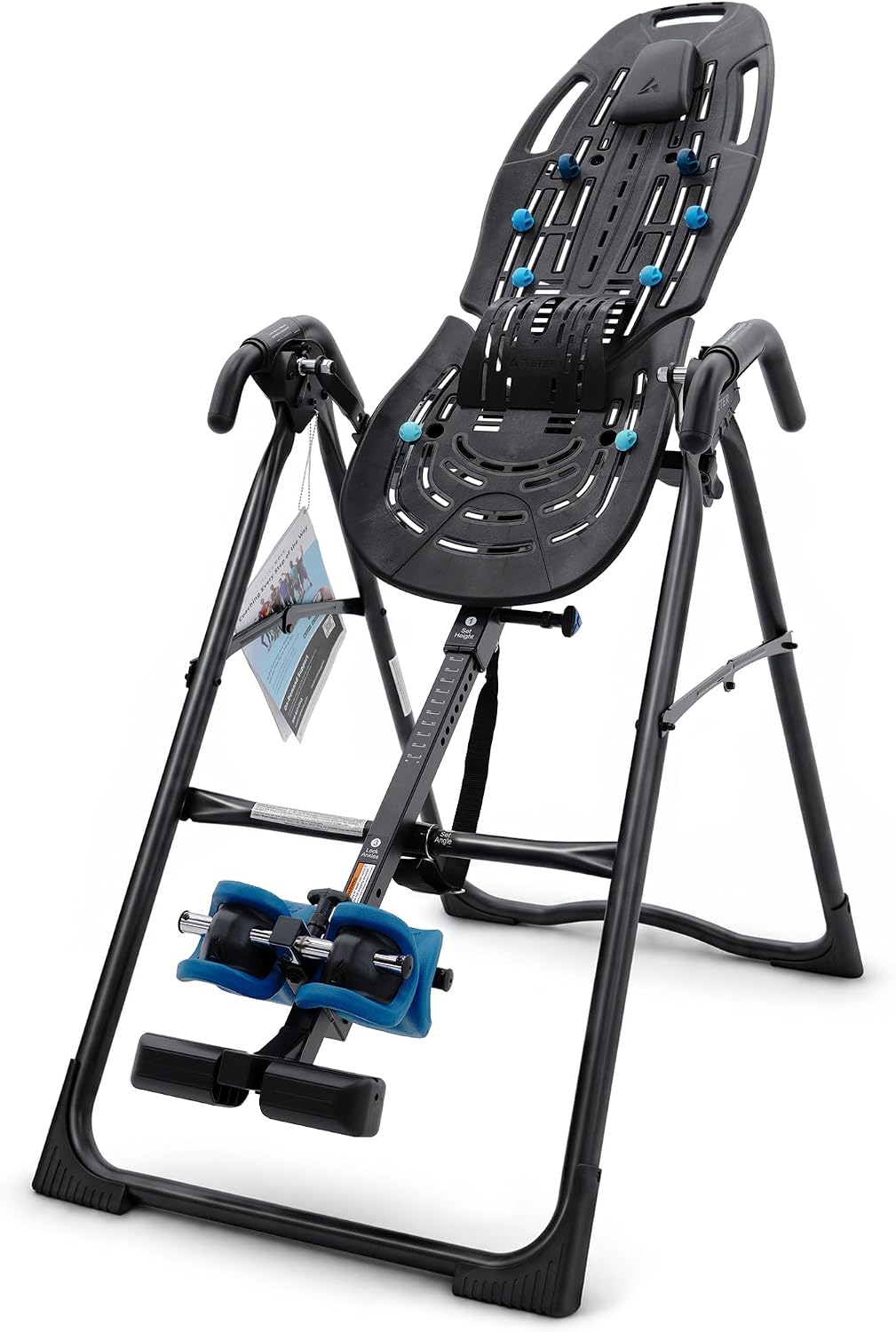
The Teeter EP-560 stands out for its combination of straightforward setup, controlled inversion, and supportive construction. It arrives mostly assembled, while the remaining setup is designed to be relatively intuitive and can take around 15 minutes.
Instead of relying on a traditional lock-and-pin system for inversion angles, this model uses a strap that allows users to select their desired degree of inversion. The ankle straps and overall construction provide a secure feeling, while the controlled movement helps reduce the sudden sensation that can occur with some inversion tables.
Comfort is another strong point. The head area is cushioned, while adjustable nodules can be positioned to target specific pressure points. The main drawback is its relatively bulky and heavy design, which can make folding and storage less convenient.
| Pros | Cons |
|---|---|
| Easy setup | Bulky and heavy |
| Precise strap-based angle control | Storage can require more space |
| Comfortable padding and adjustable nodules | 300-pound weight capacity |
Specifications: Weight: 58.2 pounds | Dimensions: 48.5 x 30 x 8.9 inches | Height range: 4 feet 8 inches to 6 feet 6 inches | Weight capacity: 300 pounds
2. Innova ITX9600 Inversion Table

The Innova ITX9600 is a practical option for shoppers who want a relatively simple and cost-conscious inversion table. Assembly takes approximately 30 to 45 minutes and is generally straightforward once the components are laid out.
After assembly, the table provides a comfortable headrest and backrest, while the ankle straps feel sturdy and secure. Its uncomplicated design makes it suitable for users who prefer a conventional inversion-table experience without an extensive list of additional features.
One important characteristic is the speed of movement when the table is inverted. It can move backward quickly, which may feel abrupt to people who are new to inversion. Experienced users looking for an affordable option may find the ITX9600 especially appealing.
| Pros | Cons |
|---|---|
| Cost-effective design | Inversion can feel abrupt |
| Comfortable headrest and backrest | Longer assembly than Teeter EP-560 |
| Sturdy ankle straps | Better suited to users comfortable with inversion |
Specifications: Weight: 58 pounds | Dimensions: 46 x 28 x 63 inches | Height range: 4 feet 10 inches to 6 feet 6 inches | Weight capacity: 300 pounds
3. Teeter FitSpine X3 Inversion Table

The Teeter FitSpine X3 is designed for users who want more than basic inversion. Its lumbar bridge helps create a deeper stretch, making the table particularly interesting for people who want to focus on the lower-back area during their stretching routine.
The padded backrest helps keep the body positioned comfortably while inverted and includes eight acupressure nodes designed to target specific sore areas. Traction side handles provide additional control, allowing users to twist or move their bodies to customize their stretch.
The wraparound ankle cups lock and release easily, contributing to a secure experience. However, the ankle cups may become less comfortable during full inversion. Assembly can take approximately 30 minutes to an hour, and the instructions may require additional attention, so watching an instructional video can be helpful.
| Pros | Cons |
|---|---|
| Lumbar bridge for deeper stretching | Ankle cups may be less comfortable at full inversion |
| Eight acupressure nodes | Assembly can take up to an hour |
| Traction side handles | Instructions may take some effort to follow |
Best for: Users who want a feature-rich inversion table with additional options for lower-back stretching and targeted pressure.
4. Teclor Inversion Table
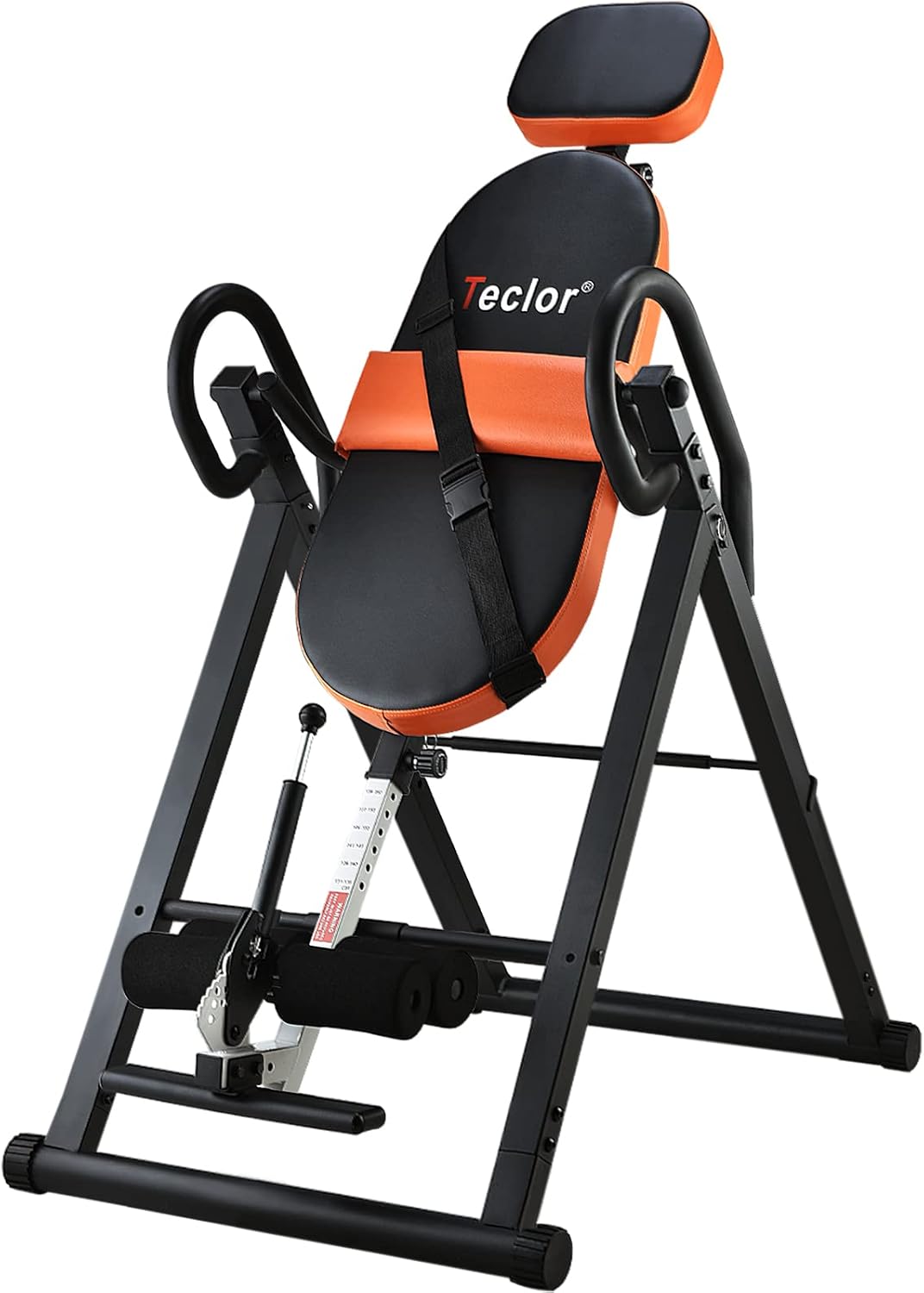
The Teclor Inversion Table focuses on a straightforward and sturdy design with useful control during stretching. Its padded, spring-loaded ankle locking system and safety belt make it easy to secure yourself before beginning an inversion session.
The wide backrest is designed with comfort in mind, giving users plenty of surface area for support. This model also offers a 350-pound maximum weight capacity, making it an attractive option for larger users who need more capacity than many standard inversion tables provide.
The height adjustment can accommodate users up to 6 feet 8 inches tall. While that extended range adds versatility, taller users should still pay attention to their positioning and comfort when reaching deeper inversion angles.
| Pros | Cons |
|---|---|
| 350-pound maximum capacity | Very tall users should check full-inversion comfort |
| Wide padded backrest | Simple design may not suit users wanting premium extras |
| Spring-loaded ankle locking system | Large frame requires adequate floor space |
Best for: Users who prioritize a sturdy design, generous weight capacity, wide padding, and a broad height range.
5. Innova Health and Fitness ITX1200 Inversion Table

The Innova Health and Fitness ITX1200 takes a different approach for people who are not immediately comfortable with the idea of hanging upside down. Stretch handles provide something to hold onto, allowing users to support themselves during stretching rather than simply relying on the inverted position.
Comfort is another focus. The table includes double-padded ankle support and an adjustable lumbar feature, giving users additional ways to customize their position. These features can be especially useful for people who want a more controlled and supported stretching experience.
Overall, the ITX1200 is a sensible option for shoppers who want an inversion table with additional support features rather than a purely basic design. Its combination of stretch handles, padded ankle support, and lumbar adjustment makes it worth considering for a home stretching setup.
| Pros | Cons |
|---|---|
| Stretch handles provide extra support | May not appeal to users wanting a minimalist design |
| Double-padded ankle support | Requires sufficient home floor space |
| Adjustable lumbar support | Individual comfort preferences vary |
Best for: Users who want additional support while stretching and prefer having handles, padded ankle support, and lumbar adjustment.
Which Inversion Table Is Best for You?
For shoppers who want a premium, well-rounded option, the Teeter EP-560 is a compelling choice thanks to its easy setup, controlled strap-based inversion, comfortable padding, and supportive design.
If affordability is your priority, the Innova ITX9600 offers a straightforward approach without unnecessary complexity. Users who want more stretching-focused features may prefer the Teeter FitSpine X3, particularly because of its lumbar bridge, acupressure nodes, and traction handles.
For larger users, the Teclor Inversion Table deserves attention because of its 350-pound capacity and height adjustment up to 6 feet 8 inches. Meanwhile, the Innova ITX1200 is a useful choice for people who want stretch handles and additional ankle and lumbar support.
Final Buying Guide
The best inversion table is ultimately the one that matches your body size, comfort preferences, available space, and experience level. Pay close attention to weight capacity, height adjustment, ankle security, inversion control, padding, and storage requirements before making your decision.
Whichever model you choose, start gradually and follow the manufacturer’s instructions. A controlled and comfortable approach is generally preferable to immediately attempting the deepest possible inversion angle.
Affiliate Disclosure: As an Amazon Associate, we may earn from qualifying purchases made through links on this page. Product prices and availability may change.
Related Posts

5 Best Cantilever Umbrellas for Comfortable Outdoor Living
A good cantilever umbrella can transform a patio, deck, poolside…

5 Best Soft Mattresses to Sink Into for Plush, Cloud-Like Comfort
If you love the feeling of sinking into a soft,…

5 Best Patio Dining Sets for Stylish, Comfortable Outdoor Dining
Choosing the right patio dining set can transform an ordinary…