
How to Choose the Best Charger
The right charger depends on the devices you use, how quickly you need them charged, how many devices you want to power at once, and whether portability is important. A compact 20W charger can be ideal for phones and earbuds, while a 65W or 100W multi-port charger makes more sense for laptops, tablets, phones, and other demanding devices. If you frequently travel away from wall outlets, a portable power bank can also be a useful addition.
The five options below cover several common charging needs, from compact everyday wall chargers to high-output USB-C charging and wireless charging stands. Each product has different strengths, so the best fit depends on your particular devices and charging habits.
Anker 735 Nano II 65W 3-Port USB-A/USB-C

The Anker 735 Nano II is a versatile choice for anyone who wants one compact wall charger to handle several types of devices. It combines two USB-C ports with a USB-A port, making it useful when you have newer USB-C devices alongside accessories or cables that still use USB-A.
Its 65W single-port maximum output gives it enough power for compatible laptops such as MacBooks and Chromebooks while also working well with phones and tablets. When multiple ports are used simultaneously, however, the available power is divided among the connected devices. The top USB-C port retains priority, while the other ports receive less power as more devices are connected.
For travel, commuting, or a compact desk setup, the 735 Nano II offers a useful combination of power and port variety. It is particularly practical when you want to charge a laptop and phone from one wall outlet rather than carrying several separate adapters.
| Pros | Cons |
|---|---|
|
|
Anker A2348 20W Dual Port USB-A/USB-C 2-Pack

The Anker A2348 20W 2-pack is designed for everyday phone and small-device charging. Each compact charger combines USB-C and USB-A connectivity, so you can use modern USB-C cables while retaining compatibility with USB-A charging cables and accessories.
The USB-C port can provide up to 20W when used individually, which makes this charger suitable for fast charging compatible smartphones. Having two chargers in the package also makes it convenient to keep one at home and another in a bag, office, bedroom, or other frequently used location.
Its small size is another practical advantage. Rather than carrying a larger multi-port power brick for simple phone charging, you can use this compact option for routine charging. The main limitation is its lower overall power compared with 65W and 100W laptop-oriented chargers.
| Pros | Cons |
|---|---|
|
|
UGreen Nexode 100W USB-C Charger

The UGreen Nexode 100W USB-C charger is built for users who need substantial charging power and several ports in one unit. It provides four charging ports, including three USB-C ports and one USB-A port, giving it broad compatibility with laptops, tablets, smartphones, and smaller accessories.
The first two USB-C ports can deliver up to 100W individually, while the remaining USB-C and USB-A ports offer lower maximum outputs. This makes the charger especially useful when you want to power a compatible laptop and another device at the same time. As with other multi-port chargers, the available power changes when multiple devices are connected.
GaN technology helps the charger provide high power in a more compact form than many traditional silicon-based power adapters. It is still heavier than smaller 20W and 65W options, but the additional output and four-port design can make the extra size worthwhile for people carrying several devices.
| Pros | Cons |
|---|---|
|
|
2-Pack Miady 10000mAh Power Bank

The Miady 10000mAh 2-pack is a practical option when portability and having a spare power source are important. Instead of buying one battery pack, this package provides two compact power banks, making it convenient for couples, families, travel partners, or anyone who wants one for different bags.
Each unit offers a 10,000mAh capacity and includes multiple output options. USB-C and micro-USB connections are available for input, while the USB-C and USB-A ports provide flexible charging options for compatible devices. The compact design also makes the power banks easier to carry during travel, commuting, or outdoor activities.
One consideration is that micro-USB is an older connector type, although the USB-C input provides a more modern alternative. Overall, the two-unit package focuses on convenience and flexibility rather than extremely high-speed charging, making it useful as a backup power solution when wall outlets are unavailable.
| Pros | Cons |
|---|---|
|
|
Anker MagGo 2-in-1 Wireless Charging Stand
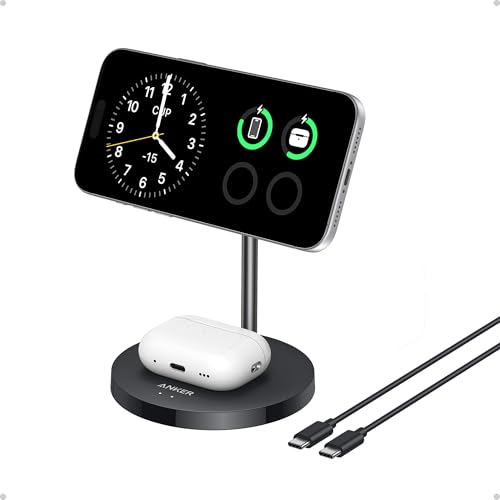
The Anker MagGo 2-in-1 Stand takes a different approach to charging by combining wireless charging with an upright stand design. Instead of leaving an iPhone flat on a desk, the stand keeps the phone elevated and visible, making it easier to check notifications, calls, widgets, or the time while charging.
Its magnetic charging design helps compatible iPhones snap into position, while the stand’s adjustable viewing angle makes it useful on a desk or nightstand. Compatible AirPods can also be charged on the lower charging surface, giving the stand a convenient two-device charging arrangement.
The charger supports up to 15W wireless charging for compatible devices, with performance depending on the device and charging setup. Its magnetic connection is also useful for maintaining alignment while charging. This makes it particularly attractive for users who prefer a visible charging stand over a traditional flat wireless charging pad.
| Pros | Cons |
|---|---|
|
|
Final Thoughts on the Best Chargers
These five charging products cover very different use cases. The Anker 735 Nano II focuses on compact multi-device wired charging, while the Anker A2348 2-pack is aimed at straightforward everyday phone charging. The UGreen Nexode steps up to 100W power and four ports for users with laptops and multiple devices. The Miady 2-pack adds portable backup power, while the Anker MagGo provides a convenient wireless charging stand for compatible iPhones and AirPods.
Before buying, check your devices’ charging requirements, the cables you already own, the number of ports you need, and whether you prioritize portability or maximum output. Choosing based on those factors can help you get a charger that fits your everyday setup rather than simply choosing the highest wattage.
Related Posts

The 5 Best Inversion Tables for Back Stretching and Home Use
Finding the right inversion table can make a big difference…

5 Best Pizza Cutters for Clean, Easy Slices
A good pizza cutter should glide through the crust, keep…

Best Wireless Earbuds: Top 5 Picks for Sound, ANC, Comfort & Battery Life
Choosing the right wireless earbuds means balancing sound quality, active…