
Best HDMI Switches for 4K, 8K, and Gaming: Top 5 HDMI Switch Reviews
Choosing the right HDMI switch can make your home entertainment setup easier to manage, especially when you have multiple gaming consoles, streaming devices, Blu-ray players, and computers connected to a single television or monitor. The best HDMI switch for your setup should offer reliable signal transmission, convenient input selection, and compatibility with the resolution, refresh rate, and audio equipment you use.
In this guide, we compare five HDMI switches with different capabilities, including HDMI 2.1 switching, 4K at 120Hz support, 8K compatibility, audio extraction, and remote control convenience. Whether you are upgrading a gaming room, organizing a home theater, or connecting several entertainment devices to one display, these options offer different approaches to managing your HDMI connections.
Although the requested keyword is “Best rust resistant air fryer,” the supplied products are HDMI switches rather than air fryers. To keep the recommendations accurate and useful, this article focuses on the five supplied HDMI products and their advertised features. Rust resistance is not a relevant selection criterion for these electronic devices.
Quick Comparison: Top 5 HDMI Switches
What to Look for When Choosing an HDMI Switch
Before selecting an HDMI switch, consider how many devices you need to connect, which resolutions your display supports, and whether you need advanced audio features. An HDMI switch combines several source inputs into a single output, allowing you to select which device appears on your television or monitor without repeatedly disconnecting cables.
- Input capacity: Choose a 3-in-1, 4-in-1, or 5-in-1 switch according to the number of devices you use.
- Resolution and refresh rate: A 4K 120Hz switch is more appropriate for supported high-refresh-rate gaming setups than a 4K 60Hz model.
- HDMI generation: HDMI 2.0 and HDMI 2.1 devices have different bandwidth capabilities. Check the complete signal chain before purchasing.
- Audio extraction: Optical and 3.5mm outputs can help connect compatible sound systems, headphones, and external audio equipment.
- Remote control: A remote can make input switching easier when the equipment is mounted behind a television or stored inside a cabinet.
- Compatibility: Check HDR formats, HDCP requirements, ARC or eARC support, and any gaming features you rely on.
For more technology and product buying guides, visit Omnixbuy to explore additional product information and recommendations.
1. HDMI 2.1 eARC Switch 4 in 1 Out with Audio Extractor

The HDMI 2.1 eARC Switch 4 in 1 Out is designed for users who need to connect multiple HDMI devices to a single display while taking advantage of higher resolutions and refresh rates. Its advertised support for 4K at 120Hz and 8K at 60Hz makes it a potential option for compatible gaming consoles, modern televisions, and high-resolution entertainment systems.
The four-input configuration is useful for a living room or gaming station containing several source devices. Instead of swapping cables whenever you want to change between a console, streaming device, computer, or media player, you can select the desired input using the supplied remote. This arrangement can also help keep an entertainment center organized and reduce wear from repeatedly unplugging HDMI connectors.
Audio extraction and eARC-related capabilities may make this model particularly interesting to home theater users. However, the exact audio formats, output behavior, bandwidth, and compatibility depend on the device specifications and connected equipment. Before purchasing, confirm that the switch supports the particular combination of resolution, refresh rate, HDR, audio format, and HDMI features required by your setup.
Key Features
- Four HDMI inputs feeding one display output.
- Advertised support for 4K at 120Hz and 8K at 60Hz.
- Audio extraction functionality.
- Remote control for convenient input selection.
- Designed for compatible modern entertainment and gaming systems.
Pros and Cons
| Pros | Cons |
|---|---|
| Four inputs accommodate several devices. | Advanced features require compatible source and display hardware. |
| Advertised high-resolution and high-refresh-rate support. | Audio and HDR passthrough details should be verified before purchase. |
| Remote control simplifies source selection. | May be more advanced than necessary for basic television use. |
Who Should Buy It?
Consider this model if you need four HDMI inputs and want to investigate a switch advertised for high-refresh-rate gaming and high-resolution video. It is particularly relevant for users whose systems include a compatible 4K 120Hz television, modern console, or audio setup that benefits from extraction features. Verify the complete specifications before relying on any specific advanced feature.
Verdict: This is a feature-focused option for users who need several HDMI connections alongside advertised HDMI 2.1-class capabilities. Its suitability depends on confirming the exact signal and audio support needed for your devices.
2. GANA HDMI Switch 3 in 1 Out with Pigtail HDMI Cable

The GANA HDMI Switch 3 in 1 Out is aimed at people who want to connect three HDMI sources to a television or monitor without investing in a more complex switching system. Its compact form factor and pigtail HDMI cable design are practical considerations for smaller entertainment setups, desktop workstations, and secondary displays.
A three-input switch can be useful when a television has limited HDMI ports but must accommodate a streaming player, game console, and laptop or another media source. Rather than moving cables around each time you change devices, you can use the switch to manage those connections. The integrated cable also means that the connection to the display does not require a separate HDMI cable for that particular link, although the individual source connections still need to be arranged appropriately.
This model is a more straightforward choice than a feature-rich switch with multiple audio outputs. Buyers should check the product listing for its exact supported resolution, refresh rate, power requirements, and switching method. Do not assume that a product described as a 4K HDMI switch supports 4K at 120Hz; the maximum supported refresh rate and signal bandwidth are separate specifications that matter for gaming and high-performance displays.
Key Features
- Three HDMI source inputs and one output.
- Integrated pigtail HDMI cable design.
- Compact format for smaller entertainment areas.
- Useful for connecting multiple everyday HDMI devices.
- A straightforward alternative to repeatedly swapping cables.
Pros and Cons
| Pros | Cons |
|---|---|
| Three inputs serve common home entertainment needs. | Fewer inputs than four- or five-port alternatives. |
| Integrated cable can simplify the display connection. | Cable placement may limit positioning flexibility. |
| Suitable for a basic multi-device setup. | Advanced gaming and audio features should not be assumed. |
Who Should Buy It?
The GANA switch is worth considering for users with three source devices and a display that does not have enough available HDMI ports. It may suit a bedroom television, a secondary gaming display, or a basic home entertainment arrangement where simple source switching matters more than specialized audio extraction or advanced HDMI 2.1 functionality.
Verdict: This is the simpler alternative in the group. Check the current Amazon listing for the exact resolution and refresh-rate limits to ensure that it meets your display requirements.
3. HDMI 2.1 Switch 4K 120Hz with Audio Extractor

This HDMI 2.1 switch is designed for a more demanding entertainment environment in which several high-performance sources must share one display. Its advertised 4K 120Hz support is relevant to compatible gaming consoles and computers, while the four-input arrangement allows multiple devices to remain connected at the same time.
The listed feature set includes VRR, ALLM, HDCP 2.3, ARC and eARC-related capabilities, HDR, CEC, and several audio output options. These features address different parts of an entertainment setup. Variable Refresh Rate can help compatible gaming systems and displays synchronize refresh timing, while Auto Low Latency Mode can help supported devices switch into a low-latency display mode. CEC may enable compatible equipment to share certain control functions. Actual behavior depends on the connected hardware and configuration.
Audio extraction is another reason to investigate this model. Optical and 3.5mm outputs can help integrate compatible soundbars, speakers, receivers, or other audio equipment. However, not every output supports every surround format, and a product’s advertised feature list does not guarantee that every combination of high-resolution video and advanced audio will work simultaneously. Check the technical documentation for supported bandwidth, chroma formats, HDR passthrough, audio codecs, and eARC behavior before purchasing.
Key Features
- Four HDMI inputs and one display output.
- Advertised 4K 120Hz support.
- Listed VRR and ALLM gaming-related features.
- Optical and 3.5mm audio output options.
- Advertised ARC/eARC, HDR, CEC, and HDCP 2.3 features.
Pros and Cons
| Pros | Cons |
|---|---|
| Four inputs accommodate a multi-device setup. | Feature compatibility requires careful verification. |
| Advertised 4K 120Hz support suits compatible gaming displays. | Cable quality and connected-device capabilities still matter. |
| Multiple audio-related features provide setup flexibility. | Advanced audio passthrough may vary by format and connection. |
Who Should Buy It?
Consider this option if you connect several gaming or media devices and want a switch advertised with modern gaming features and separate audio outputs. It is especially relevant for users who need to coordinate a compatible television, console, computer, and external sound system. Review the exact product specifications to confirm that all essential features are supported together.
Verdict: Its advertised feature set makes it an option for advanced gaming and home theater installations. The most important purchasing step is verifying real compatibility with your source devices, display, and audio equipment.
4. 8K HDMI Switch 3 in 1 Out with Remote
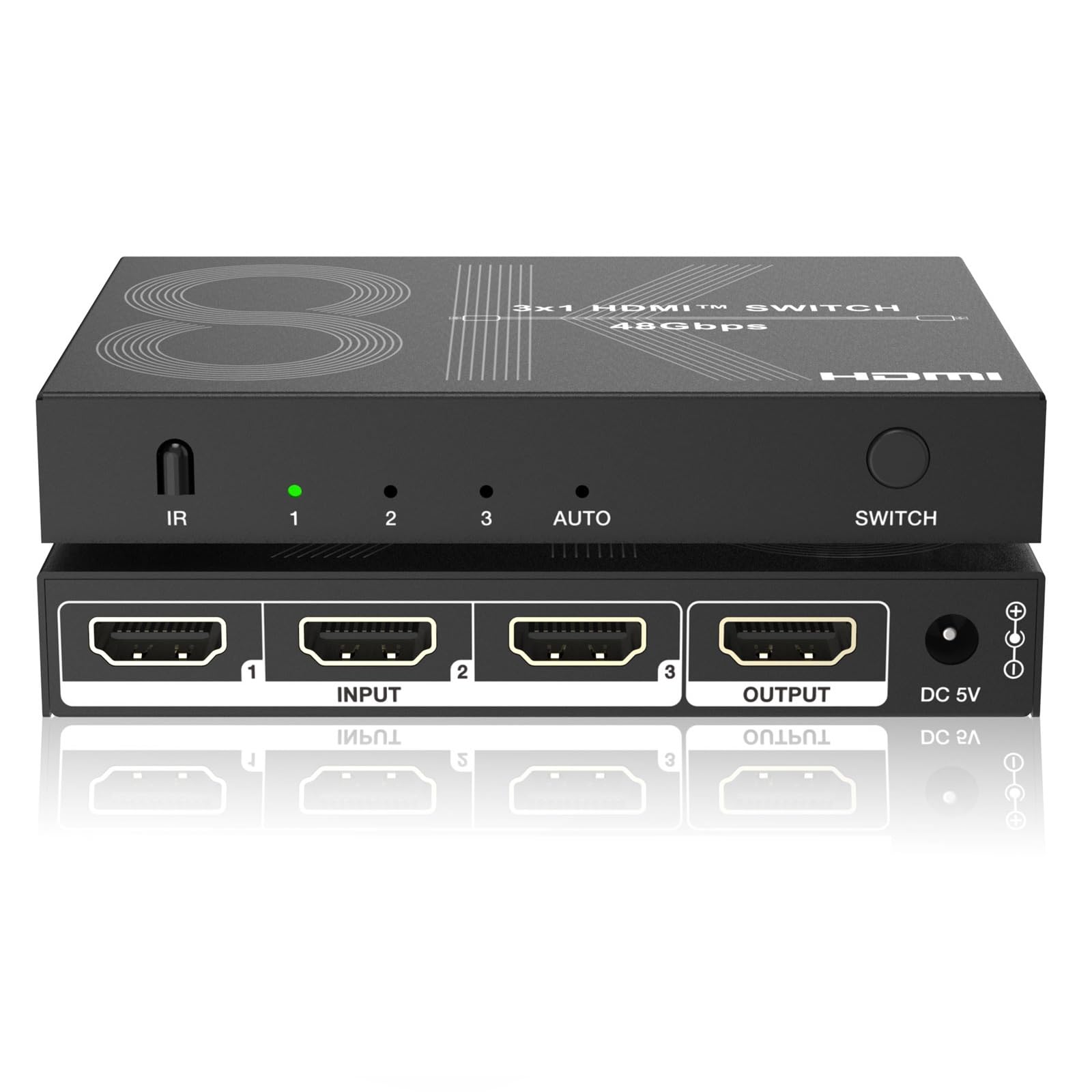
The 8K HDMI Switch 3 in 1 Out with Remote is aimed at users who want to switch among three HDMI sources while keeping their equipment connected. The product title also advertises 4K at 120Hz support, making it worth investigating for a compatible television or monitor used with gaming consoles and other modern devices.
The three-input arrangement provides a straightforward way to share a single display between a console, streaming player, computer, or another HDMI source. A remote is particularly useful when the switch is located on a television stand, behind a screen, or inside an entertainment cabinet. It can help avoid the inconvenience of reaching around equipment every time you want to change inputs.
The advertised 8K and 4K 120Hz capabilities are important specifications to verify rather than assume. Successful transmission depends on the source device, switch bandwidth, display, and HDMI cables. Buyers should also check whether their required HDR format, HDCP version, and audio return features are supported. If your setup only needs standard 4K video at 60Hz, a simpler switch might be sufficient; if you require high-refresh-rate gaming, the exact supported signal formats become much more important.
Key Features
- Three HDMI inputs feeding one output.
- Advertised 8K compatibility.
- Advertised 4K 120Hz support.
- Remote control for input switching.
- Designed to consolidate multiple entertainment sources.
Pros and Cons
| Pros | Cons |
|---|---|
| Three inputs suit a modest home theater or gaming station. | May not provide enough inputs for larger systems. |
| Remote control offers convenient access to input selection. | Remote operation depends on correct placement and operation. |
| Advertised high-resolution support offers flexibility for compatible equipment. | Exact bandwidth and format compatibility need confirmation. |
Who Should Buy It?
This switch is worth considering if you have three HDMI sources and prefer remote-operated input selection. It may be appropriate for a console and streaming setup, particularly when your display supports the advertised resolutions. Check the listing carefully if you require specific features such as 4K 120Hz with HDR, variable refresh rate, or a particular surround-sound format.
Verdict: A potentially practical choice for users seeking three-input switching and remote convenience. Its real value depends on verified compatibility with the resolution, refresh rate, and audio features of your equipment.
5. 5 in 1 Out HDMI 2.0 Switch with Audio Extractor

The 5 in 1 Out HDMI 2.0 Switch with Audio Extractor is designed for users who need to connect several HDMI sources and route the selected video signal to a single display. With five inputs, it offers more connection capacity than the three- and four-input alternatives in this roundup. This can be useful for a home theater containing a console, streaming box, computer, Blu-ray player, and an additional source device.
The product title advertises 4K at 60Hz, HDR10, HDCP 2.2, 18Gbps bandwidth, Dolby Vision and Atmos-related compatibility, ARC, optical output, and a 3.5mm audio connection. Audio extraction can be helpful when a television or display does not offer the audio connection you need for external speakers or a receiver. The optical output is particularly relevant for compatible audio equipment, while a 3.5mm connection can suit certain powered speakers or other analog audio devices.
This model is based on HDMI 2.0 specifications, so it should not be treated as a substitute for an HDMI 2.1 switch when 4K at 120Hz is essential. Its advertised 4K 60Hz capability is more suitable for compatible standard-refresh-rate displays and many everyday media applications. Also note that ARC is not the same as eARC, and support for an audio format can depend on the selected output, source configuration, and receiving equipment. Review these details before purchasing to avoid compatibility surprises.
Key Features
- Five HDMI inputs and one output.
- Advertised 4K at 60Hz support.
- HDMI 2.0 and 18Gbps bandwidth listed in the product title.
- Optical and 3.5mm audio outputs.
- Advertised HDR10, HDCP 2.2, Dolby Vision, Atmos-related, and ARC features.
Pros and Cons
| Pros | Cons |
|---|---|
| Five inputs accommodate a larger collection of source devices. | HDMI 2.0 is not intended for 4K 120Hz switching. |
| Optical and 3.5mm outputs provide audio connection options. | Supported audio formats can vary by output and configuration. |
| Advertised HDR and 4K 60Hz support suit compatible displays. | ARC support should not be confused with eARC. |
Who Should Buy It?
Consider this model if your entertainment system has many source devices and you want separate audio output options. It may be a suitable fit for a 4K 60Hz home theater or media center that does not require 4K 120Hz gaming. Confirm the supported audio formats and HDR behavior if your system includes a receiver, soundbar, or Dolby Vision-capable display.
Verdict: The five-input design is its main attraction, especially for users with many connected devices. Its advertised HDMI 2.0 capabilities make it a different type of option from the high-refresh-rate HDMI 2.1 switches above.
Which HDMI Switch Is Right for You?
The best choice depends on the number of devices you need to connect and the capabilities of your television, monitor, and audio equipment. Instead of choosing solely by the advertised maximum resolution, compare the exact supported combinations of resolution, refresh rate, HDR, audio, and control features.
| Your Priority | Product to Consider | Why |
|---|---|---|
| High-resolution video and audio extraction | HDMI 2.1 eARC Switch | Advertised 4K 120Hz, 8K 60Hz, and audio extraction. |
| Simple three-device switching | GANA HDMI Switch | Three inputs and a compact pigtail cable design. |
| Gaming features and audio outputs | HDMI 2.1 4K 120Hz Switch | Advertised VRR, ALLM, and audio extraction. |
| Three inputs with remote control | 8K HDMI Switch | Remote input selection and advertised high-resolution support. |
| Five inputs and separate audio outputs | 5-in-1 HDMI 2.0 Switch | More source connections and optical/3.5mm audio options. |
Frequently Asked Questions
1. What does an HDMI switch do?
An HDMI switch lets multiple source devices share a single HDMI input on a television or monitor. You select the source you want to view without repeatedly unplugging and reconnecting HDMI cables.
2. Is an HDMI 2.1 switch better than an HDMI 2.0 switch?
Neither is automatically better for every user. HDMI 2.1-class equipment can support higher bandwidth and features such as 4K at 120Hz when the entire connection supports them. HDMI 2.0 equipment can be appropriate for many 4K 60Hz applications and may be sufficient for a standard home theater.
3. Can an HDMI switch support 4K at 120Hz?
Some switches advertise 4K at 120Hz support, but buyers should verify the supported signal formats and bandwidth. The source, switch, display, and HDMI cables must all support the required signal. A product described as 4K-compatible does not necessarily support 120Hz.
4. What is the difference between ARC and eARC?
ARC and eARC are audio return technologies used with compatible televisions and audio equipment. eARC offers greater audio bandwidth and supports a broader range of advanced audio formats than conventional ARC. The exact capabilities depend on the connected equipment and the way the switch handles audio return.
5. Why would I need an HDMI audio extractor?
An audio extractor can route audio from an HDMI signal to a separate audio output, such as optical or 3.5mm, when the device supports that connection. It can be useful for connecting compatible external speakers, receivers, or other audio equipment. Check the supported audio formats before buying.
6. Does an HDMI switch improve picture quality?
An HDMI switch generally manages signal routing rather than improving the original picture. A suitable switch should pass the supported signal without reducing its resolution or refresh rate. Incompatible equipment, insufficient bandwidth, or incorrect settings may prevent the expected video format from working properly.
7. How many HDMI inputs should I choose?
Count all the devices you want to keep connected, including gaming consoles, streaming players, computers, and disc players. A three-input switch can suit a modest setup, while a four- or five-input model offers more flexibility for a larger entertainment center.
8. Are these HDMI switches rust resistant?
Rust resistance is not a primary specification for the HDMI switches reviewed here. Their suitability depends on electrical compatibility, signal performance, construction, and operating conditions. Keep electronic switching equipment dry and follow the manufacturer’s installation and care instructions.
9. Can I use an HDMI switch with a PS5 or Xbox?
An HDMI switch may work with a PS5 or Xbox if it supports the console’s required video, audio, and copy-protection features. For 4K 120Hz gaming, confirm that the switch and every connected component support the required signal. A standard 4K 60Hz switch may limit the available gaming output.
10. Should I choose a switch with a remote?
A remote is convenient if the switch is difficult to reach or if you frequently change between source devices. For a setup where the switch is easily accessible, a simpler input-selection method may be sufficient. Check which control methods the particular product includes.
Final Verdict
These five HDMI switches serve different needs, ranging from simple three-source switching to multi-input systems with advertised high-refresh-rate video and audio extraction. The HDMI 2.1 eARC switch and the HDMI 2.1 4K 120Hz model are worth investigating for compatible advanced gaming or home theater setups. The GANA model offers a simpler three-input approach, the 8K switch adds remote-operated switching, and the five-input HDMI 2.0 model provides extra connection capacity and separate audio outputs.
Before placing an order, check the current Amazon product listing for the exact technical specifications, included accessories, compatibility limitations, and price. Give particular attention to resolution and refresh-rate combinations, HDR formats, audio passthrough, ARC/eARC behavior, and HDCP requirements. Those details are more useful for selecting the right HDMI switch than choosing by the highest advertised resolution alone.
Please note that this comparison covers the five HDMI products supplied for this article, not rust-resistant air fryers. If your intended topic is kitchen appliances, the product selection would need to consist of air fryers with documented corrosion-resistant materials and finishes.
Check HDMI 2.1 Switch Price
Check GANA Switch Price
Disclosure: This article contains Amazon affiliate links. As an Amazon Associate, the publisher may earn from qualifying purchases made through these links, at no additional cost to the buyer. Product specifications, availability, and prices may change; consult the current product listing before purchasing.
Related Posts

Best High-Quality Air Fryer for Couples: Top 5 Picks, Accessories, and Buying Guide
Best High-Quality Air Fryer for Couples: Top 5 Picks, Accessories,…

5 Best Handheld Fans for Staying Cool on the Go All Summer Long
A good handheld fan can make hot commutes, outdoor events,…

Best Air Fryer for Refrigerator Storage: Top 5 Air Fryer Reviews and Buying Guide
Best Air Fryer for Refrigerator Storage: Top 5 Air Fryer…