
Best Stainless Steel Air Fryer for Dorm Rooms: Top 5 Electric Fryer Reviews
Finding the best stainless steel air fryer for dorm rooms can be challenging when you want convenient cooking, easy cleanup, and a compact appliance that fits your available space. Stainless steel kitchen appliances are popular for their durable appearance, practical construction, and ability to complement modern kitchens. However, choosing the right countertop fryer requires more than looking at its exterior. You should also consider capacity, temperature controls, power requirements, oil management, storage, and whether your dormitory permits the appliance.
This guide compares five stainless steel electric deep fryers with different capacities and basket configurations. Although these products are oil-based deep fryers rather than air fryers, they can help readers comparing countertop frying appliances understand the differences between smaller home models and larger commercial-style options. If your goal is specifically air frying with little or no oil, look for an actual air fryer instead. The five products below are evaluated according to their listed features, potential everyday uses, and practical considerations for dorm living.
Before purchasing any electric fryer for a residence hall, check the housing rules. Many dormitories restrict deep fryers and other appliances that use hot oil because of fire hazards, electrical loads, and ventilation concerns. A stainless steel exterior does not make an oil fryer equivalent to an air fryer or automatically make it suitable for a dorm room.
Top 5 Stainless Steel Electric Fryers at a Glance
2. VEVOR Dual-Tank Fryer

Dual oil tanks and high-power commercial-style design.
What to Consider Before Buying a Fryer for a Dorm Room
Counter space is often limited in dormitories, so measuring the available surface is important. Compare an appliance’s complete dimensions, including handles, lids, and removable baskets, with your intended storage location. Also consider where the appliance can be cleaned, how hot oil will be handled, and whether you have a safe, permitted electrical outlet. A compact footprint alone does not guarantee that a fryer is appropriate for student housing.
Capacity is another important factor. Smaller home-oriented fryers may be more practical for occasional individual portions, while dual-tank and commercial-style models generally make more sense for larger kitchens or shared cooking environments where permitted. Larger tanks require more oil and more careful handling. The advertised capacity should not be confused with the quantity of food that can be cooked evenly in one batch.
Finally, distinguish deep frying from air frying. Deep fryers cook food in heated oil, whereas air fryers circulate hot air around food and typically require little or no added oil. If your main priorities are minimizing oil, reducing cleanup, and preparing quick snacks, a compact air fryer may better match your needs. The five products reviewed below are deep fryers, not verified air fryers.
1. OSTBA Electric Deep Fryer with 3 Baskets, 4.75QT Stainless Steel Countertop
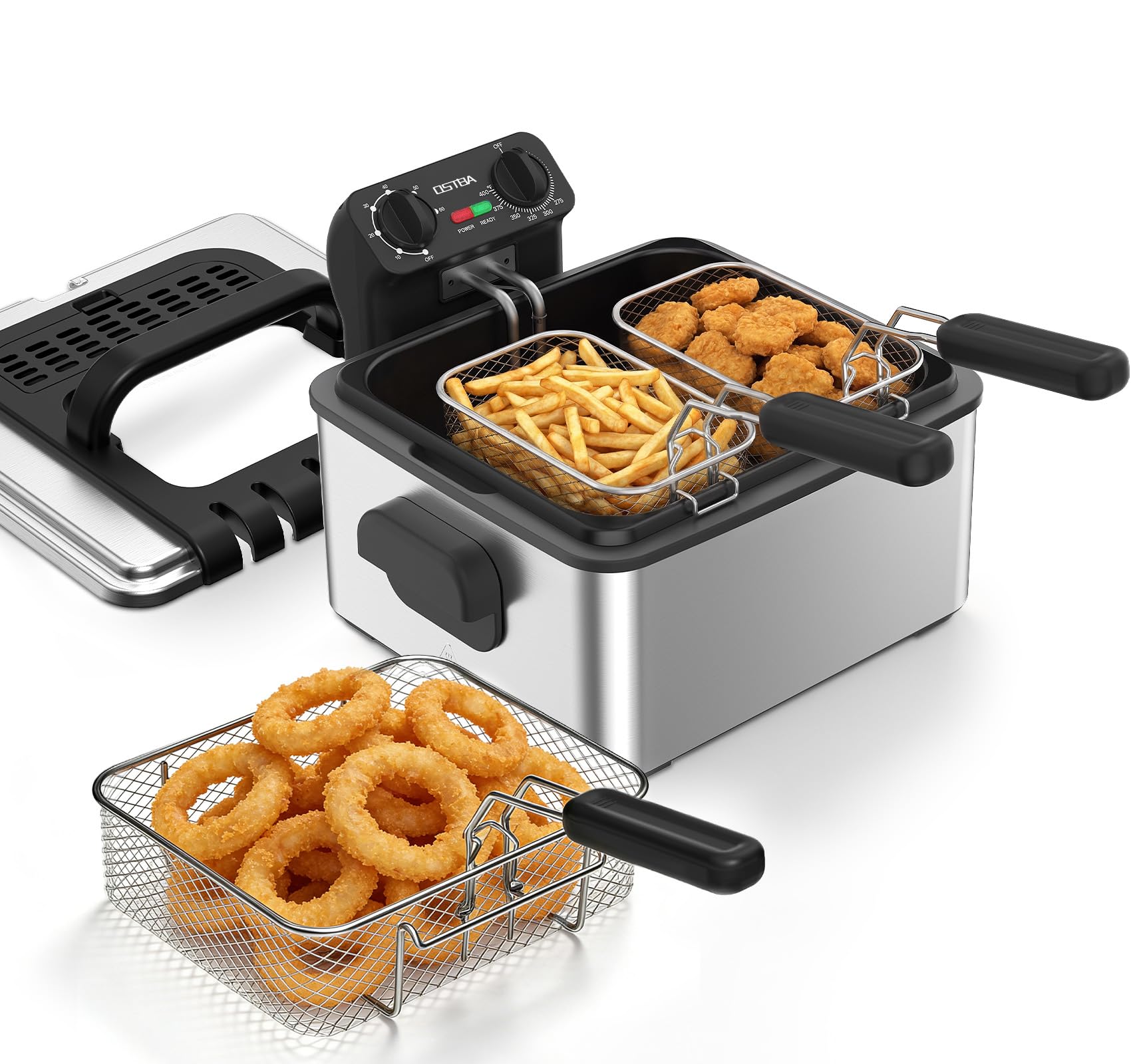
The OSTBA 4.75-quart electric deep fryer is a home-oriented option for shoppers who want a stainless steel countertop appliance with multiple baskets. Its advertised three-basket configuration offers flexibility when preparing different fried foods. Depending on the basket sizes and the manufacturer’s intended loading instructions, this setup may help separate smaller portions instead of placing everything in one large basket. That can be useful for households that prepare several snack varieties or different ingredients.
The listed 4.75-quart capacity places this model closer to a home-use fryer than a large commercial unit. However, a capacity figure does not establish the appliance’s exact countertop footprint or the amount of food it can cook efficiently at once. Check the manufacturer’s dimensions and operating instructions before deciding whether it fits your available kitchen space. Stainless steel surfaces can also complement other kitchen equipment, although the precise materials used in each component should be confirmed in the product specifications.
For a student, the main appeal is the combination of a moderate listed capacity and multiple baskets. Even so, this remains an oil-based deep fryer, so it should not be treated as a space-saving air fryer. Hot oil introduces additional storage, cleaning, and fire-safety concerns. Before considering this product for a dormitory, confirm that deep fryers are explicitly allowed by the housing authority. If oil frying is prohibited, a permitted compact air fryer or another approved cooking appliance would be a more appropriate choice.
Key Features
- Listed 4.75-quart capacity.
- Three-basket configuration for separating portions.
- Stainless steel countertop styling.
- Designed for electric deep frying rather than air frying.
- Potentially useful for small households or shared kitchens where permitted.
Pros and Cons
| Pros | Cons |
|---|---|
| Multiple baskets provide portion flexibility. | Requires hot cooking oil. |
| Moderate listed capacity for home use. | Dormitory approval must be confirmed. |
| Stainless steel appearance suits many kitchens. | Not an air fryer and may need more cleanup than one. |
Who Should Consider It?
Consider this model if you need a multiple-basket deep fryer for a permitted home or shared kitchen. Students seeking a true air fryer should compare air-circulation models instead. Check current availability, dimensions, safety features, and the complete manufacturer’s specifications before ordering.
2. VEVOR Commercial Deep Fryer 3000W with Dual Oil Tank, 2 x 9.1 Qt
The VEVOR commercial deep fryer is a larger, high-power option designed around two oil tanks. Its listing specifies 3000 watts of power and two 9.1-quart tanks, making it substantially more oriented toward batch cooking than the typical compact appliance used for an individual snack. Dual tanks can be helpful when preparing separate foods or managing different batches, provided the manufacturer’s controls and operating instructions support the intended use.
The dual-tank arrangement offers a practical advantage in suitable kitchens: different foods can be cooked separately, and separate tanks may help avoid transferring flavors between batches. Nevertheless, users should verify the exact temperature-control arrangement, tank independence, basket accessories, and cleaning procedure from the manufacturer’s documentation. The 3000-watt rating also deserves attention. Electrical compatibility depends on the voltage, circuit capacity, and outlet requirements specified for the actual unit, so it should never be connected to an unsuitable circuit or an overloaded extension lead.
For dorm-room use, the main disadvantages are its commercial-style capacity, power demand, and hot-oil requirements. A large dual-tank fryer is unlikely to be the most convenient choice for a student with limited counter space and storage. It is also not an air fryer. This model makes more sense for a permitted commercial or larger home kitchen than a typical residence hall. Students should prioritize approved, compact appliances with clear safety instructions rather than assuming that stainless steel construction makes a high-powered fryer suitable for a small room.
Key Features
- Listed 3000W electrical power rating.
- Two oil tanks, each advertised at 9.1 quarts or approximately 8.6 liters.
- Commercial-style deep-frying configuration.
- Potential for preparing separate batches in different tanks.
- Best evaluated for suitable kitchens with adequate electrical capacity.
Pros and Cons
| Pros | Cons |
|---|---|
| Dual-tank layout offers batch flexibility. | Large capacity is impractical for many dorm rooms. |
| High listed power rating for its intended application. | Requires careful electrical compatibility checks. |
| Useful for suitable high-volume frying tasks. | Uses hot oil and is not an air fryer. |
Who Should Consider It?
This VEVOR model is worth comparing if you need a dual-tank commercial-style deep fryer for a kitchen that can accommodate its size and electrical requirements. It is not a sensible first choice for a typical dorm room. Review the official specifications, safety instructions, and housing restrictions before purchase.
3. OSTBA 20.7QT Commercial Electric Deep Fryer with Basket, Stainless Steel
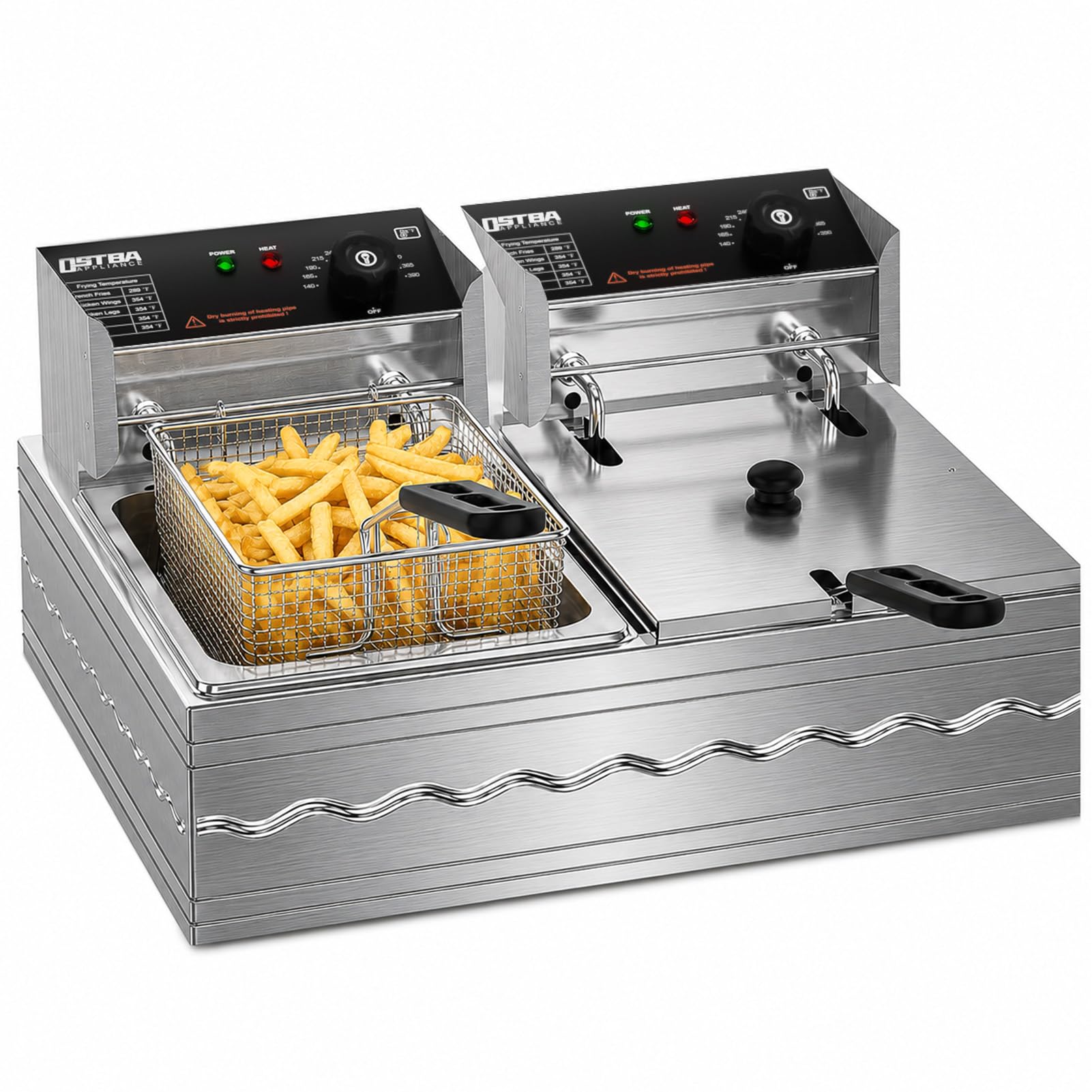
The OSTBA 20.7-quart commercial electric deep fryer is aimed at users who need considerably more capacity than a compact household fryer. Its listed capacity makes it a potential candidate for larger batches, group meals, or suitable food-preparation environments. The stainless steel styling gives the appliance a professional countertop appearance, while the basket-based design provides a familiar way to lower and remove food from hot oil.
Large-capacity fryers can reduce the need to prepare numerous small batches when cooking for several people. However, the actual cooking performance depends on heater output, temperature recovery, food quantity, and the manufacturer’s operating guidance. A larger tank also means more oil to handle and store, plus more space needed for cleaning and safe cooling. Confirm the product’s dimensions, electrical rating, included accessories, and any removable components before deciding whether it is appropriate for your kitchen.
For a dormitory, this product’s size is a significant drawback. Students typically need appliances that can be stored easily, cleaned without a dedicated sink area, and operated within strict residence-hall rules. A 20.7-quart oil fryer does not meet the usual priorities of compact air frying. Its more suitable environment is a larger, permitted kitchen where high-volume deep frying is needed. If your primary goal is quick snacks without maintaining a large volume of oil, consider a small air fryer approved by your housing provider instead.
Key Features
- Advertised 20.7-quart capacity.
- Electric deep-frying design with a basket.
- Stainless steel exterior styling as indicated by the product title.
- Designed for larger food batches than compact household fryers.
- Requires sufficient countertop space and safe oil-handling arrangements.
Pros and Cons
| Pros | Cons |
|---|---|
| Large advertised capacity for batch cooking. | Too large for many student living spaces. |
| Basket design supports lifting food from oil. | Oil handling and cleanup require extra care. |
| Commercial-style construction and appearance. | Not designed for air frying or minimal-oil cooking. |
Who Should Consider It?
Choose this category of fryer only if large-batch deep frying is a genuine requirement and you have a permitted, appropriately equipped kitchen. For students, smaller approved cooking appliances are generally more practical. Verify the manufacturer’s current instructions and product specifications before making a decision.
4. Classic Cuisine Deep Fryer, 4L Electric Oil Fryer, Silver

The Classic Cuisine 4-liter electric oil fryer offers a relatively straightforward alternative to the larger commercial-style models in this comparison. Its listed dimensions are 16 by 12.5 by 9 inches, giving shoppers a useful starting point when estimating the countertop area it may occupy. Its silver finish also provides a neutral appearance that can blend with other kitchen appliances. The 4-liter capacity makes it worth comparing for occasional home frying, although the appliance is still substantially different from a small air fryer.
One benefit of checking the dimensions before buying is that it helps you plan the appliance’s placement and storage. Remember to leave appropriate clearance around heating appliances and follow the manufacturer’s ventilation and operating requirements. You should also confirm the product’s temperature settings, safety features, basket design, and cleaning instructions rather than assuming those details from its exterior appearance. Capacity alone does not establish how quickly food cooks or how consistently the oil temperature is maintained.
This model may be easier to accommodate than a large commercial fryer, but the stated footprint still deserves careful consideration in a dormitory. The listed dimensions do not include any extra clearance that might be required during operation. In addition, hot oil can create substantial spill and burn risks in a small room. Check your residence-hall rules before purchasing it. If permitted cooking options are limited, an approved compact air fryer or another appliance with a smaller cooking footprint may be more convenient for everyday student meals.
Key Features
- Advertised 4-liter oil capacity.
- Silver-colored electric deep-fryer design.
- Listed dimensions of 16 x 12.5 x 9 inches.
- Suitable for comparison with other home-use oil fryers.
- Requires safe oil storage, cleaning, and cooling space.
Pros and Cons
| Pros | Cons |
|---|---|
| Clear listed dimensions help with space planning. | The footprint may still be large for a dorm desk or shelf. |
| 4-liter capacity suits comparison with home-use fryers. | Uses oil rather than hot-air circulation. |
| Neutral silver finish. | Requires careful handling and cleaning after frying. |
Who Should Consider It?
The Classic Cuisine fryer is worth considering for permitted home kitchens where a 4-liter oil fryer meets the user’s cooking needs. Students should compare its measurements against their actual available space and confirm that the appliance is allowed. If the goal is an air fryer for a dorm room, look for a product specifically designed to circulate hot air instead.
5. 1800W Deep Fryer with 3 Baskets, 5.3QT/21Cup Electric Oil Fryer

This 1800-watt electric deep fryer advertises a 5.3-quart capacity and three baskets. Those specifications suggest a home-oriented appliance intended to offer flexibility when frying multiple portions. The three-basket arrangement may be useful for separating different foods, handling smaller quantities, or organizing ingredients during meal preparation. Shoppers should verify the precise basket sizes and arrangement in the manufacturer’s product information before assuming that all baskets can accommodate a full serving simultaneously.
The listed 1800W rating is an important consideration when evaluating electrical compatibility. Compare the required voltage and current with your kitchen’s available circuit, and follow the manufacturer’s instructions. The 5.3-quart figure should also be interpreted carefully: advertised capacity does not necessarily mean the appliance can cook that volume of food at once. Food should be loaded according to the manufacturer’s guidance to avoid overcrowding and unsafe oil displacement. Confirm the temperature controls, removable components, cleaning procedure, and safety protections before purchasing.
Among these five options, this model combines a moderate advertised capacity with a three-basket configuration, but that does not make it a verified dorm-friendly appliance. Deep frying requires hot oil, suitable ventilation, stable placement, and careful cleanup. Many student residences prohibit this category of appliance. If your housing policy permits only compact, lower-risk cooking equipment, choose an approved alternative. For someone specifically looking for a stainless steel air fryer, it is important to compare actual air fryers instead of relying on deep-fryer listings.
Key Features
- Advertised 1800W power rating.
- Listed 5.3-quart or 21-cup capacity.
- Three-basket configuration.
- Home-use electric oil fryer design.
- Requires electrical compatibility and housing-policy checks.
Pros and Cons
| Pros | Cons |
|---|---|
| Three baskets provide portion flexibility. | Not an air fryer despite the related search topic. |
| Moderate listed capacity for home frying. | Hot oil requires safe placement and careful handling. |
| Listed power rating helps electrical planning. | Actual dorm suitability depends on housing rules. |
Who Should Consider It?
Consider this three-basket fryer for a permitted home kitchen if you want to prepare different fried foods and its verified dimensions fit your available counter. Students should confirm the housing rules and electrical requirements first. For low-oil cooking in a dorm, a genuine compact air fryer is the more relevant category to investigate.
Comparison Table: Five Electric Deep Fryers
| Product | Listed Capacity | Main Configuration | Best-Suited Use |
|---|---|---|---|
| OSTBA 4.75QT | 4.75 quarts | Three baskets | Home frying in a permitted kitchen |
| VEVOR Dual-Tank | 2 x 9.1 quarts | Dual tanks, 3000W | Higher-volume frying |
| OSTBA 20.7QT | 20.7 quarts | Commercial-style basket | Large batches in suitable kitchens |
| Classic Cuisine 4L | 4 liters | Electric oil fryer | General home frying |
| 1800W Three-Basket Fryer | 5.3 quarts | Three baskets, 1800W | Flexible portions in a permitted kitchen |
Specifications in this table are based on the supplied product titles and should be confirmed on the current Amazon listings or manufacturer’s documentation. None of the five listed products is identified as an air fryer. Product availability, price, dimensions, included accessories, and safety certifications may vary.
How to Choose the Right Fryer for Student Living
1. Check Dormitory Appliance Restrictions
This is the first step, not an afterthought. Residence halls may ban deep fryers, appliances with exposed heating elements, or equipment that uses large quantities of cooking oil. Ask the housing office for its written appliance policy before spending money. Never assume an appliance is permitted simply because it is marketed for home use or has a stainless steel finish.
2. Measure the Available Space
Measure the countertop, shelf, or approved cooking area and compare it with the manufacturer’s full product dimensions. Include the space needed to open the lid, remove the basket, clean the appliance, and keep it away from walls and combustible materials as directed. A large commercial fryer may be difficult to store safely in a shared room.
3. Consider Power Requirements
Check voltage, wattage, plug type, and manufacturer requirements. High-wattage appliances can place a substantial load on an electrical circuit, particularly when used alongside computers, chargers, kettles, or other equipment. Never exceed circuit limits or use an unsuitable extension cord or adapter.
4. Evaluate Cleaning and Storage
Oil fryers require safe cooling, oil disposal or storage, and careful cleaning. Stainless steel may be practical to wipe down, but not every component is dishwasher-safe or removable. Read the cleaning instructions and consider whether you have a suitable place to clean and store the appliance without creating spills or attracting pests.
5. Decide Whether You Actually Need an Air Fryer
If your main goals are preparing fries, reheating leftovers, roasting vegetables, or making quick snacks with minimal added oil, a true air fryer may be a better fit. Look for compact dimensions, simple controls, removable dishwasher-safe parts where available, and an explicitly permitted appliance category. Stainless steel exterior styling is optional; safety, suitability, and ease of use should come first.
Frequently Asked Questions
What is the best stainless steel air fryer for dorm rooms?
None of the five products reviewed here is identified as an air fryer; all five are electric deep fryers that use oil. For a dorm room, look for a genuine compact air fryer and verify that your housing policy permits it. Choose based on footprint, capacity, cleaning requirements, and electrical specifications rather than exterior material alone.
Can I use a deep fryer in a college dorm room?
That depends on the residence hall’s written rules. Many dormitories prohibit deep fryers because hot oil can cause fires and severe burns. Do not operate one unless your housing authority explicitly permits it and you can follow all safety requirements.
Is a stainless steel air fryer better than a plastic one?
Not necessarily. Stainless steel can provide a durable-looking exterior and may be easy to wipe clean, but the quality of the heating system, internal materials, controls, safety protections, and overall construction also matter. Some air fryers combine metal and heat-resistant plastic components. Evaluate the full appliance rather than choosing solely by exterior material.
What capacity is suitable for one student?
A compact air fryer is often easier to store and manage for individual portions, but the ideal capacity depends on your meals and available space. Check the manufacturer’s stated food capacity, basket dimensions, and exterior measurements. Do not confuse an oil tank’s capacity with the amount of food that can be cooked in one batch.
Do deep fryers cook food with less oil than air fryers?
No. Deep fryers immerse food in hot oil, while air fryers circulate hot air and usually need little or no added oil. The finished nutritional profile depends on ingredients, preparation, and cooking method, but air frying is generally the more relevant choice for people trying to minimize added cooking oil.
Are three-basket fryers useful for small kitchens?
Multiple baskets can help separate food portions, but the overall appliance may still occupy considerable space. Check the exterior dimensions, basket sizes, oil capacity, and cleaning requirements. For a small kitchen or dormitory, a compact permitted appliance may be more convenient than a multi-basket oil fryer.
How do I clean a stainless steel electric fryer?
Follow the manufacturer’s cleaning instructions. Switch off and unplug the appliance, then allow the oil to cool completely before handling it. Never pour oil down a drain or immerse electrical components in water. Only remove parts that the manufacturer identifies as removable, and use compatible cleaning products for stainless steel surfaces.
What should I check before buying an electric fryer on Amazon?
Check the current product description, exact model number, dimensions, capacity, voltage, wattage, included baskets, warranty, return conditions, and manufacturer support. Review recent customer feedback for recurring concerns about temperature control, leakage, durability, or cleaning. Confirm that the listing matches the product you intend to buy and that its use is allowed in your living environment.
Final Verdict: Which of These Five Fryers Should You Choose?
Each of these five products serves a different deep-frying use case. The OSTBA 4.75-quart model and the 1800W three-basket fryer advertise multiple-basket configurations for home use. The Classic Cuisine 4-liter model provides a straightforward capacity option, while the VEVOR dual-tank unit and OSTBA 20.7-quart model are more oriented toward larger-volume frying. The right choice depends on verified specifications, your cooking needs, available space, and the manufacturer’s safety guidance.
For a typical dorm room, however, the most important distinction is that these are oil-based deep fryers rather than air fryers. Their hot-oil requirements can make them unsuitable for student housing, even when their size appears manageable. Confirm your residence hall’s policy before purchasing any of them. If you specifically want low-oil cooking, look for a genuine compact air fryer with clear safety instructions and dimensions that fit your approved cooking area.
Use the links above to review each product’s current listing, compare its specifications, and confirm availability before ordering. Prices, discounts, and stock can change, so check the latest details on Amazon rather than relying on an assumed price.
Affiliate disclosure: This article contains Amazon affiliate links. As an Amazon Associate, the publisher may earn from qualifying purchases made through these links, at no additional cost to the buyer.
Related Posts

The 5 Best Science Kits for Kids: Fun STEM Experiments, Robotics, and Electronics
Looking for the best science kits for kids to inspire…

5 Best LEGO Car Sets for Gifting: Ultimate Technic Supercars and Racing Models
Looking for the perfect gift for a LEGO enthusiast, car…

5 Best Electric Screwdrivers for DIY Projects, Home Repairs, and Precision Work
The best electric screwdriver can make furniture assembly, household repairs,…